
How RevOps Reduces Sales Tool Sprawl & Cleans Data
February 3, 2026
By
Evie Secilmis
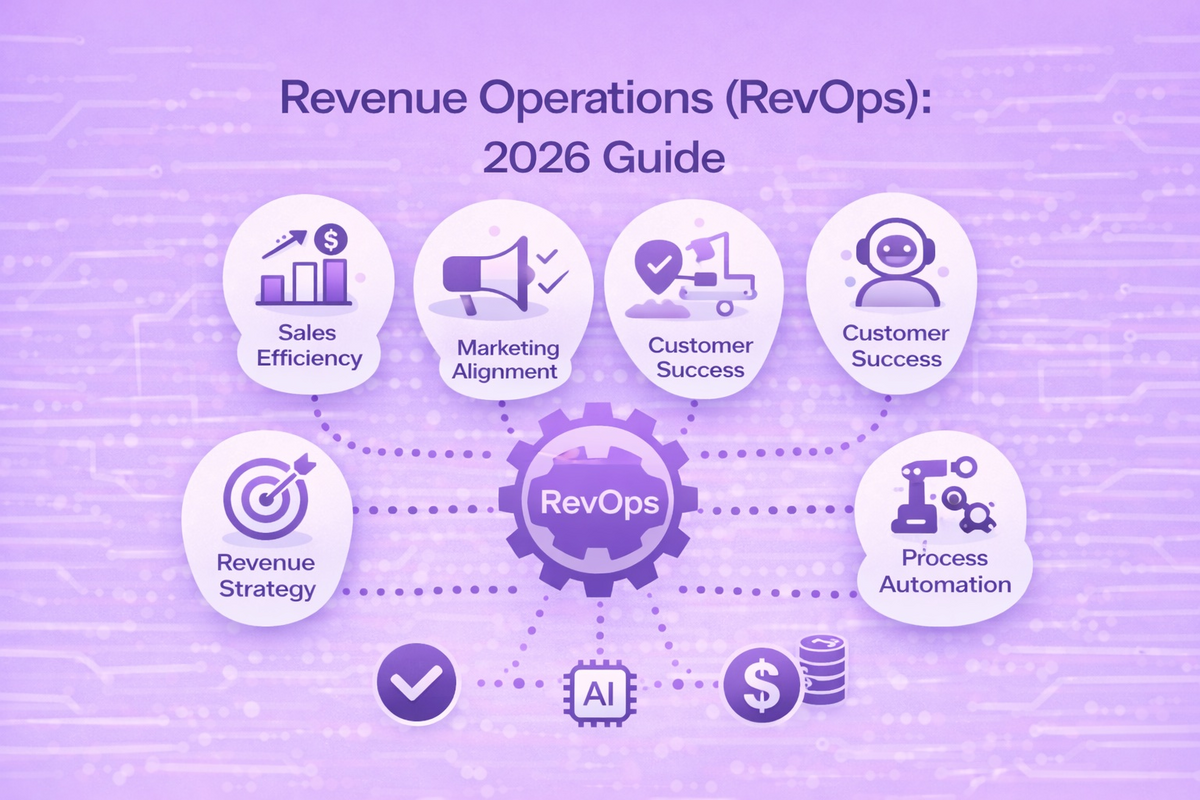

Sales uses Salesforce. Marketing is in HubSpot. Customer Success has dashboards in Tableau. Sound familiar? Each team defines "qualified lead" differently. Nobody agrees on churn numbers. When the CEO asks "How's revenue?", you get three different answers. This chaos is a symptom of a bigger problem: a disconnected tech stack and poor data quality across siloed systems. So, how can RevOps reduce sales tool sprawl while improving data quality? It starts by treating your data as a core asset and implementing the governance needed for a clean, reliable foundation.
This isn't just frustrating — it's expensive. Misalignment between revenue teams costs B2B companies 10–30% of potential growth. Duplicate tools waste budget. Bad data slows decisions. Process gaps lose deals.
Revenue operations (RevOps) fixes this. It unifies people, processes, data, and technology across the entire revenue organization.
What Is Revenue Operations (RevOps)?
Revenue operations is the function that aligns sales, marketing, and customer success to drive predictable, efficient revenue growth. RevOps brings tools, data, processes, and analytics together in one place. It creates a single source of truth for the whole revenue org.
In traditional setups, each team ran their own operations. Sales ops sat under sales. Marketing ops sat under marketing. CS ops stayed in CS. Each team improved their own function, but nobody owned the full revenue picture. Marketing measured leads. Sales measured bookings. CS measured satisfaction. No one tracked end-to-end efficiency.
RevOps changes this by putting all operations under one team. Instead of three separate ops functions, one RevOps team serves marketing, sales, and customer success. That team owns:
- CRM administration
- Process design
- Tool selection
- Data governance
- Reporting and analytics
Why did RevOps take off? A few key reasons:
- Subscription businesses need to focus on lifetime value, not just new logos
- Buyers touch marketing, sales, and CS at different points in their journey
- Revenue tech stacks have grown too complex for each team to manage alone
- CROs need operational support across their entire org
Companies with mature RevOps grow revenue 10–20% faster than peers. They also spend 10–15% less on sales and marketing. The savings come from eliminating redundant tools, standardizing processes, and making faster data-driven decisions.
Why RevOps Matters More Than Ever
The Problem: Why Revenue Teams Are Drowning in "Firefighting"
Your operations team was hired to build a strategic growth engine, but they spend most of their time putting out fires. If this sounds familiar, you’re not alone. One recent report found that 67% of RevOps professionals can’t do the jobs they were hired for because they’re too busy with reactive tasks. The primary culprit is often poor data quality. When your systems are filled with inaccurate or incomplete information, it creates a domino effect of problems: sales cycles slow down, forecasts are unreliable, and leadership loses trust in the reports they’re given. This constant "firefighting" prevents your team from focusing on the high-impact work that actually moves the needle on revenue.
The Payoff: The Financial Impact of a RevOps Strategy
When you successfully align your people, processes, and technology, the results are transformative. Companies with a mature RevOps function grow revenue 10–20% faster than their peers and can see up to 28% higher profits. This isn't just about working harder; it's about working smarter. By creating a single source of truth and standardizing processes, you eliminate friction across the entire customer lifecycle. This alignment also leads to significant cost savings—often 10–15% less spending on sales and marketing—by removing redundant tools and enabling faster, data-driven decisions. When your operational foundation is solid, your sales team can spend less time on administrative work and more time building relationships and closing deals with the help of a streamlined AI deal desk.
What Does a RevOps Team Actually Do?
How RevOps Reduces Sales Tool Sprawl
RevOps owns the full revenue tech stack: CRM, marketing automation, sales engagement, CS platforms, analytics tools, and the integrations between them. This includes vendor selection, setup, and ongoing maintenance.
Instead of each team picking tools in isolation, RevOps evaluates everything through a revenue lens. Will it integrate with the CRM? Does it create useful data? Does it reduce complexity or add to it? This prevents tool sprawl.
Tool consolidation is a major RevOps focus. Many orgs end up with 3 email tools, 4 analytics platforms, and a pile of overlapping point solutions. RevOps cleans that up — eliminating redundancy and redirecting budget to higher-value tools.
CRM ownership is especially critical. Sales teams using proposal automation need CRM integration for opportunity tracking, document management, and workflow automation. RevOps makes sure those integrations work.
Streamlining Your Go-to-Market Processes
RevOps designs and documents processes across marketing, sales, and CS. This covers lead management, deal qualification, deal desk procedures, contract approvals, customer onboarding, expansion, and renewals.
Good process documentation prevents waste. When a new sales rep can't find the approval process for a non-standard deal, deals stall. When CS doesn't know the sales-to-CS handoff process, customer expectations aren't met. RevOps builds playbooks that scale knowledge across teams.
Process improvement starts with finding where things break down. RevOps tracks metrics like lead response time, pipeline velocity, and quote-to-close time — then runs experiments and measures results.
Cross-functional handoffs get special attention. The marketing-to-sales handoff often breaks because nobody owns it. RevOps does. They define what a qualified lead looks like, set SLAs for follow-up, and measure conversion end-to-end.
Maintaining Data Quality Across Siloed Systems
Data quality is the foundation of RevOps. Without it, reporting is unreliable and decisions are made on bad information. RevOps sets data standards, validation rules, and governance policies across all systems.
Field standardization drives huge value. If marketing, sales, and CS each define "industry" differently, reporting falls apart. RevOps standardizes fields, enforces required inputs, and validates data quality automatically.
Data integration connects disconnected systems. Marketing automation syncs with CRM. CS platforms pull in customer data. Finance needs revenue figures. RevOps builds and monitors these integrations.
Master data management prevents duplicates and keeps account hierarchies clean. RevOps sets up deduplication rules, merge procedures, and hierarchy management so the CRM stays usable as data pours in.
Understanding the Causes of Data Silos
Data silos are what happen when different teams—like marketing, sales, and customer success—keep their information in separate systems that don’t talk to each other. Marketing might live in HubSpot, while sales works out of Salesforce, and neither platform has the complete story on a customer. This separation is often unintentional, caused by teams having different goals, using too many disconnected tools, or lacking clear rules for data governance. When each department operates from its own island of information, you lose the ability to see the full customer journey, making it incredibly difficult to create a seamless experience.
Combating Natural Data Decay
Even with perfect integration, your data has a shelf life. Information naturally decays over time as people change jobs, companies merge, and contact details become outdated. This leads to common problems like duplicate customer records, inconsistent formatting (think "CA" versus "California"), and critical missing fields. Without a dedicated function to manage it, your CRM can quickly become a minefield of unreliable information. This isn't just a minor inconvenience; it actively slows down sales cycles, leads to inaccurate forecasts, and erodes leadership's trust in reports.
When your core data is unreliable, every downstream process suffers. This is especially painful for teams that need to generate proposals and respond to RFPs using accurate customer information. If the data feeding your sales documents is wrong, the quality of your response will be compromised from the start. RevOps tackles this head-on by establishing processes for data cleansing and enrichment, ensuring your team is always working with the most current and accurate information available.
Turning Data into Actionable Insights
RevOps builds the reporting infrastructure that answers revenue questions. Key questions it should be able to answer instantly:
- How is pipeline generation trending?
- What is our win rate by segment?
- How is retention performing?
- What is sales rep productivity?
Instead of each team building dashboards with different definitions, RevOps creates unified reporting with shared logic. When the CEO asks "what's our pipeline?", everyone references the same number calculated the same way.
Revenue attribution improves significantly under RevOps. Understanding which marketing programs influence deals requires tracking touchpoints across systems. RevOps builds multi-touch attribution models that give marketing proper credit.
Forecasting accuracy also improves. By standardizing opportunity stages and tracking historical conversion rates, RevOps enables statistical forecasting that gives leaders a more reliable view of the future.
Unifying Content, Training, and Execution
RevOps often owns revenue enablement: onboarding, ongoing training, sales plays, competitive intel, and content management. Centralizing this prevents duplication across functions.
Tool training is critical. When RevOps rolls out new technology, they also build training programs to drive adoption. Low adoption kills tool ROI — RevOps ownership prevents this.
Process enablement helps teams follow through. RevOps creates job aids, checklists, templates, and automation that make the right process the easy process.
How to Structure Your RevOps Team
Choosing Your Team Model: Centralized or Federated?
There are three common structures:
- Fully centralized: All ops functions roll up to one leader. One unified team serves marketing, sales, and CS. Maximizes alignment but requires generalist skills.
- Federated: Functional ops teams stay in their departments but report dotted-line to RevOps leadership. Preserves deep functional expertise while improving coordination.
- Hybrid: A VP of RevOps leads the org, with specialized pods for sales ops, marketing ops, CS ops, and shared services (tools, data, analytics). Balances specialization with unity.
Who Do You Need on Your RevOps Team?
- RevOps Analyst: Focuses on data, reporting, and business intelligence. Builds dashboards and surfaces insights for decisions.
- RevOps Manager: Owns specific tools or processes — for example, a CRM Manager handles Salesforce administration and customization.
- Enablement Specialist: Creates training programs, manages content libraries, and drives tool adoption.
- RevOps Architect: Designs the technical infrastructure and plans the long-term evolution of the stack. Emerges in larger, more mature orgs.
What Skills Should Your RevOps Team Have?
Strong RevOps professionals combine analytical skills, technical fluency, process thinking, and business sense. They understand systems and data, but can also communicate clearly with sales, marketing, and CS.
Most RevOps hires come from ops roles within sales, marketing, or CS. Others come from consulting, finance, or analytics. Technical skills that matter: SQL, Salesforce or HubSpot, APIs and integrations, and BI tools.
Business understanding is just as important. RevOps pros need to understand sales cycles, qualification methods like MEDDIC, marketing funnel dynamics, and CS metrics to design effective processes.
Deciding on Team Size and Reporting Lines
RevOps typically reports to the CRO, CEO, or COO. Reporting to the CRO makes the most sense — it reinforces the revenue growth mandate and keeps alignment natural.
Avoid having RevOps report to a functional leader like a VP of Sales or CMO. This creates conflicts of interest when RevOps decisions affect multiple teams.
A rough guide to team size:
- Under $20M ARR: 1–2 RevOps professionals
- $50M ARR: 4–8 people
- $200M+ ARR: 15–25 people in specialized teams
The RevOps Metrics That Actually Matter
Tracking Revenue Growth and Efficiency
- Revenue growth rate (YoY, QoQ): The ultimate outcome metric. RevOps drives growth through better execution, efficiency, and faster decisions.
- Customer acquisition cost (CAC): RevOps reduces CAC through process improvements, tool consolidation, and better marketing-to-sales conversion.
- Sales cycle length: Shorter cycles mean faster revenue. RevOps finds and removes bottlenecks that slow deals down.
- Win rate by segment: Improves through better qualification, competitive intel, and sales enablement.
Measuring Your Operational Efficiency
- Lead response time: How fast sales follows up on marketing leads. Faster response dramatically improves conversion. RevOps uses automation to drive sub-hour response times.
- Pipeline velocity: How fast opportunities move through stages. Stalled deals point to process problems or skill gaps RevOps can address.
- Quote-to-close time: Long cycles often mean approval or contract bottlenecks — RevOps streamlines these.
- Sales productivity: Revenue per rep reveals whether tools, processes, and enablement are working.
How to Measure Data Quality
- CRM data completeness: Percentage of records with required fields filled in. Incomplete data breaks analytics and processes.
- Duplicate rate: High duplicate rates mean weak governance. RevOps implements deduplication rules and monitors trends.
- System adoption: Tracked by active users, login frequency, and feature use. Low adoption signals training gaps or tools that don't fit the workflow.
Core Metrics for Monitoring Data Health
Saying you want "good data" is easy, but how do you actually measure it? Vague goals lead to vague results. RevOps makes data quality tangible by tracking a few core health metrics. The first is CRM data completeness, which is just a straightforward way of asking: are the fields you need actually filled out? If key information like industry, company size, or contact role is missing from a record, you can't segment your lists, personalize your outreach, or trust your reports. It directly undermines your ability to make informed decisions. RevOps addresses this by defining which fields are mandatory and running regular audits to catch and fix incomplete records before they cause problems down the line.
Next up is the duplicate rate. Nothing erodes a team's trust in their CRM faster than duplicate records. When multiple reps are logging notes on different versions of the same account, or marketing is sending the same email twice to one person, it creates chaos. It fragments the customer story and makes your entire organization look disorganized. A high duplicate rate is a clear sign of weak data governance. A core RevOps function is to establish and enforce strict deduplication rules and processes, ensuring that you have one clean, consolidated record for every contact and company you engage with.
Finally, you have to monitor system adoption. You can have the most powerful tech stack in the world, but it’s worthless if your team isn't using it. RevOps tracks adoption by looking at metrics like daily active users, login frequency, and the usage of specific features. Low adoption is a major red flag. It might signal a need for better training, but it often means the tool doesn't fit the team's workflow or solve a real problem. When tools are difficult to use or don't integrate well, reps will always find workarounds, which usually means reverting to spreadsheets and creating new data silos. This is why focusing on platforms that simplify complex tasks and integrate seamlessly into existing processes is so critical for success.
Gauging Cross-Functional Alignment
- Marketing-sales SLA adherence: Are teams meeting commitments on lead volume, quality, and follow-up timing?
- Lead-to-opportunity conversion rate: Reveals the quality of marketing leads and the effectiveness of sales follow-up.
- Sales-accepted lead rate: Low acceptance means leads don't meet qualification standards or definitions are misaligned.
- Net revenue retention: Combines retention and expansion. RevOps aligns sales and CS on at-risk accounts and expansion opportunities.
Tracking Customer-Centric and Subscription KPIs
In a subscription business, the initial sale is just the starting line. RevOps focuses on the entire customer journey, which means tracking KPIs that measure customer health and long-term value. These metrics tell you if you're successfully keeping and growing your customer base, not just acquiring new logos.
- Customer Lifetime Value (CLV): This is the total revenue you can expect from a single customer over their entire relationship with your company. A high CLV shows you're attracting the right customers and delivering consistent value. RevOps directly impacts this by engineering smooth handoffs from sales to customer success and creating clear processes to spot expansion opportunities.
- Net Revenue Retention (NRR): This metric tracks revenue from your existing customers, accounting for upgrades, downgrades, and churn. An NRR over 100% is a powerful sign of health—it means your existing customer base is growing even without adding new ones. RevOps drives this by aligning teams on unified expansion plays and proactive retention strategies.
- Churn Rate: This is the percentage of customers or revenue lost over a specific period. RevOps helps you move beyond just tracking churn to understanding *why* it happens. By connecting data from sales, product usage, and support tickets, RevOps teams can identify patterns and build early-warning systems to flag at-risk accounts.
- Expansion MRR: This tracks the new monthly recurring revenue you generate from existing customers via upsells and cross-sells. It's a direct measure of your ability to grow with your customers. RevOps provides the operational framework for this, building the playbooks and automated triggers that help customer success and sales teams act on these opportunities at the right time.
How to Successfully Implement RevOps
Step 1: Assess Your Current State
Before designing RevOps, understand where you are today. Document your tech stack, existing processes, data quality issues, org structure, and team capabilities. Talk to stakeholders in each function to understand what's broken.
Separate quick wins from long-term initiatives. Quick wins build momentum — for example, standardizing lead routing or cutting two redundant tools. Long-term projects like a CRM migration need sustained planning and resources.
Step 2: Clean Up Your Tech Stack
Map current tools to the functions they perform. Find redundancies, gaps, and integration headaches. Then build a target architecture that consolidates tools and simplifies how they connect.
Prioritize by impact. Don't tear out tools that are working. Replace the ones causing pain — broken integrations, missing capabilities, or systems blocking growth.
Think about integration architecture early. Point-to-point integrations between individual tools don't scale. An iPaaS (integration platform as a service) or CDP (customer data platform) gives you a scalable foundation.
Key Criteria for Selecting RevOps Software
When you evaluate new tools for your stack, it’s easy to get distracted by flashy features. But a RevOps perspective forces you to look deeper. Instead of just asking what a tool *does*, you need to ask how it will function as part of your entire revenue engine. This prevents adding another complex point solution that creates more problems than it solves. Before you sign a contract, make sure the software meets these core criteria:
- Seamless Integration: Your tech stack should be a cohesive system, not a collection of siloed apps. Prioritize tools with robust, native integrations, especially with your CRM. A tool that can't communicate with your other systems will just create more data headaches and manual work. This is especially true for sales tools that manage critical deal information, like proposal software.
- Data Governance: The software should help you maintain clean data, not pollute it. Look for features like field validation, standardization options, and deduplication rules. This ensures the information flowing into your systems is reliable from the start, preventing the "garbage in, garbage out" problem that plagues so many reports.
- Clear ROI and User Adoption: A powerful tool that no one uses is just a wasted budget line. The software should fit naturally into your team's existing workflows and have a clear, intuitive interface. If a tool requires a massive change management effort to get people to use it, it's probably not the right fit.
Step 3: Standardize Your Processes
Start by documenting how things actually work today. Talk to the people doing the work — don't assume. Understanding the current state prevents designing processes that ignore real constraints.
Then design improved processes that address the pain points. Keep them as simple as possible. Complexity creates friction. Automate wherever you can to reduce manual work.
Change management is critical here. Processes fail when people don't use them. Explain why things are changing. Train teams on the new process. Monitor adherence and fix issues fast.
Step 4: Put Data Governance in Place
Set data standards for key objects: accounts, contacts, leads, and opportunities. Define required fields, field types, picklist values, and validation rules.
Assign clear data ownership. Who maintains account hierarchies? Who monitors lead data quality? Who audits CRM health? Without clear owners, data degrades fast.
Automate data quality wherever possible. Use validation rules to block bad data entry. Add duplicate detection and merge procedures. Use third-party enrichment to fill gaps.
Implementing Advanced Data Management Concepts
Once you have basic governance, RevOps can introduce more advanced concepts to create a truly reliable data foundation. This starts with master data management (MDM), a discipline focused on creating one single source of truth for your most critical data, like customer and product information. Instead of letting duplicate accounts pile up, RevOps implements deduplication rules and merge procedures that keep the CRM clean. This team also drives field standardization across every system. If marketing uses "Manufacturing" and sales uses "Industrial" for the same industry, your reporting and segmentation efforts will fail. RevOps enforces a consistent taxonomy so that everyone is speaking the same language, which is critical for accurate data analytics and reliable automation.
Ensuring Data Practices Meet Compliance Standards
Beyond just being clean, your data practices must also be compliant. RevOps takes the lead in establishing data governance policies that align with regulations like GDPR and CCPA. This isn't just about writing a policy document; it's about building compliance into your systems. For example, RevOps can implement automated workflows to manage consent or handle data deletion requests, reducing manual effort and human error. A key part of this is assigning clear data ownership. RevOps clarifies who is responsible for the quality and compliance of specific data sets—like lead data or customer contract information—ensuring there is always a person accountable for data stewardship and adherence to the rules.
Step 5: Guide Your Team Through the Change
RevOps is a big change. Marketing, sales, and CS teams must adapt to new processes, tools, and reporting. Resistance is normal — plan for it.
- Get visible executive sponsorship from the CEO or CRO. This signals that RevOps is a priority, not a side project.
- Address concerns early and directly. Why are we doing this? What problems does it solve? How will teams benefit?
- Run pilots before rolling out broadly. Test with one region or team, measure results, and refine before scaling.
Step 6: Commit to Continuous Improvement
RevOps isn't a one-time project; it's a continuous cycle of refinement. Once your initial framework is in place, the real work begins. This means constantly tracking performance, identifying new bottlenecks, and testing solutions. Your RevOps team should regularly analyze metrics like pipeline velocity and quote-to-close time to see what's working and what isn't. This data-driven approach allows you to run small, controlled experiments—like tweaking a lead scoring model or adjusting a sales playbook—and measure the impact. This iterative process ensures your revenue engine becomes more efficient over time, adapting to market changes and internal needs.
This cycle of improvement relies heavily on the foundations you've already built: clean data and standardized processes. Without reliable data, your insights will be flawed, and your experiments won't yield clear results. Maintaining high data quality across all systems is non-negotiable. This includes everything from CRM hygiene to ensuring the content in your proposal software is always current. When your team can trust the numbers, they can make smarter decisions and focus on strategic improvements rather than constantly fighting fires. This commitment to operational excellence is what separates a good RevOps function from a great one.
Common RevOps Hurdles (And How to Clear Them)
Overcoming Resistance to Change
Sales, marketing, and CS leaders sometimes resist ceding operational control. They worry about losing autonomy or responsiveness to their team's needs.
The fix: involve functional leaders in governance. A RevOps steering committee with functional representation ensures decisions account for each team's needs. RevOps serves the revenue org — it doesn't control it.
Quick wins help too. When teams see RevOps delivering real improvements — faster reporting, better lead quality, simpler processes — resistance drops.
Dealing with Technical Debt and Old Systems
Many orgs inherit years of technical mess: customizations nobody understands, integrations that break constantly, and data quality nightmares. Cleaning it up takes time.
Prioritize by business impact. Don't try to fix everything at once. Focus on the technical debt causing the most pain: broken integrations, critical data issues, or systems blocking growth.
Sometimes a clean slate is faster than incremental fixes. Migrating to a new platform can be quicker and more effective than trying to salvage a deeply broken system.
How to Address Skills Gaps on Your Team
Finding people who combine technical skills, business judgment, and cross-functional leadership is hard. Pure technologists lack business context. Pure business people lack technical depth.
Build a team that covers the range together. Not everyone needs every skill. Invest in development programs to grow RevOps talent internally — rotating high-performers through RevOps builds pipeline and spreads operational thinking across the org.
Finding Solutions for the Data Talent Shortage
The talent pool for RevOps is notoriously shallow. Finding that perfect person who understands sales strategy, marketing funnels, and CRM architecture feels like searching for a unicorn. Instead of waiting for the ideal candidate, focus on a two-part solution: upskilling your current team and leveraging technology. You can train a sharp sales ops analyst on marketing automation or teach a marketing ops manager the finer points of sales forecasting, building expertise from within. More importantly, you can use smart tools to handle the heavy lifting. For instance, AI-powered platforms can automate data entry, enforce process rules, and ensure information consistency across systems, which are core RevOps responsibilities. This approach allows you to build a capable team without having to find a single person who can do it all, letting technology fill the gaps in technical expertise.
How to Prove the ROI of RevOps
RevOps impact is often indirect. The team doesn't close deals or generate leads — they make others more effective at doing those things. That makes ROI harder to measure.
The best approach: before-and-after comparisons. Track revenue growth, sales productivity, CAC, win rates, and forecast accuracy before and after RevOps initiatives. Calculate time savings from automation. Track cost savings from tool consolidation.
User satisfaction surveys capture qualitative value. Are sales reps frustrated by the CRM? Is marketing happy with lead quality? Improvement in satisfaction is a real signal of RevOps impact.
Managing the Costs of a RevOps Initiative
It’s easy to look at RevOps as just another cost center—new salaries to pay, new tools to buy. But that view misses the bigger picture. The real cost isn’t in building a RevOps function; it’s in continuing without one. Think about the money wasted on redundant software, the deals lost to inefficient processes, and the opportunities missed because of bad data. A strong RevOps initiative is an investment in efficiency that pays for itself. Companies with a mature RevOps function actually grow revenue 10–20% faster than their peers while spending 10–15% less on sales and marketing. Those savings come directly from eliminating duplicate tools, standardizing workflows, and empowering leaders to make faster, data-driven decisions.
Improving Data Accessibility and Visualization
When your marketing, sales, and customer success teams operate in silos, they create separate reports with conflicting numbers. This leads to meetings spent arguing about whose data is correct instead of making decisions. RevOps fixes this by building a centralized reporting infrastructure. Instead of dueling dashboards, RevOps creates unified reporting with shared definitions for every key metric. When the CEO asks about pipeline trends or win rates, everyone references the same number, calculated the same way. This clarity turns data from a point of contention into a reliable asset for making faster, more confident business decisions.
Addressing Data Security and Privacy Risks
Your tech stack holds sensitive customer data, and with regulations like GDPR and CCPA, managing it securely is critical. A data breach can lead to massive fines and damage your brand's reputation. When data is spread across disconnected systems, the risk multiplies. RevOps acts as the guardian of this data by establishing clear governance policies across all systems. A key part of this is assigning clear data ownership—determining who maintains account hierarchies, monitors data quality, and audits CRM health. This proactive approach to data governance doesn't just improve reporting; it builds a secure foundation that protects both your customers and your business.
What's Next for Revenue Operations?
The Role of AI and Automation
AI is changing what RevOps can do. AI-powered forecasting, lead scoring, account health prediction, and churn risk detection are becoming standard tools. They give RevOps teams early warning signals they never had before.
AI-powered platforms automate routine RevOps work: data cleaning, report generation, anomaly detection. This frees the team for strategic work instead of operational maintenance.
Workflow automation eliminates manual handoffs. RevOps designs smart workflows that route requests, trigger alerts, and update records automatically based on business rules.
Using Predictive Analytics to Forecast Revenue
Modern analytics predict what will happen, not just report what already has. RevOps builds predictive models for pipeline conversion, churn risk, expansion likelihood, and rep success.
These predictions enable proactive action. If an account shows churn signals, CS engages early. If a deal looks stalled, managers intervene before it's too late. Predictive analytics turns RevOps from a reporting function into a strategic advisor.
Integrating Product and Customer Data
Product usage data, health scores, and behavioral signals are increasingly flowing into revenue systems. RevOps owns these integrations, making product data actionable for sales and CS.
This product-led RevOps approach recognizes that how customers use the product drives expansion and retention. RevOps ensures usage signals trigger sales plays, influence lead scoring, and inform CS prioritization.
The Rise of Revenue Intelligence Platforms
Conversation intelligence tools record and analyze sales calls. Deal intelligence platforms assess opportunity health and risk. These tools give RevOps a much richer picture of what's actually happening in deals.
RevOps evaluates, deploys, and maximizes value from these platforms. The goal is making sure insights drive action — not creating more data that nobody uses.
Frequently Asked Questions
What's the difference between sales ops and RevOps?
Sales ops focuses on the sales team only — supporting AEs, managing the CRM, analyzing pipeline, and enabling quota attainment. RevOps expands that scope to include marketing and CS. It creates unified processes, data, and analytics across the entire revenue org. Sales ops improves one function. RevOps improves how all three functions work together.
When is the right time to build a RevOps team?
Most companies set up RevOps when they hit $10M–$30M ARR and start running into coordination problems between sales, marketing, and CS. Below $10M, one ops generalist can usually cover everything. Above $30M, the complexity demands a dedicated team. Other common triggers: a data quality crisis, runaway tool sprawl, or a new CRO hire who needs unified operational support.
What core skills do RevOps professionals need?
A strong RevOps hire combines technical fluency (SQL, CRM platforms, APIs), analytical skills (data analysis, reporting), process thinking (workflow design), business acumen (understanding sales, marketing, and CS), and soft skills (cross-functional influence, change management). The key is bridging between technical setup and real business outcomes.
How big should my RevOps team be?
Team size scales with ARR and complexity:
- Under $20M ARR: 1–2 people
- $50M ARR: 4–8 people covering analytics, systems, and enablement
- $200M+ ARR: 15–25+ people in specialized teams
Budget allocation typically runs 1–3% of revenue including headcount and tools.
Does RevOps replace sales operations?
RevOps absorbs sales ops rather than replacing it. CRM management, pipeline analysis, and territory planning still happen — they're just part of a bigger RevOps org. The difference is that sales ops now coordinates with marketing ops and CS ops under shared leadership. Some companies keep sales ops reporting to the VP of Sales while building RevOps as a coordination layer on top.
What are the best ways to measure RevOps success?
Track improvements across four areas:
- Revenue metrics: growth rate, CAC, LTV, retention
- Operational efficiency: sales productivity, pipeline velocity, lead response time
- Data quality: CRM completeness, accuracy, system adoption
- Cross-functional alignment: SLA adherence, lead-to-opportunity conversion
The best signal: are sales, marketing, and CS teams actually more effective? If yes, RevOps is working.
Why RevOps Is Your New Competitive Advantage
RevOps has moved from a buzzword to a business necessity. Companies with mature RevOps functions consistently outperform peers. They execute better, decide faster, and align their revenue teams more tightly.
The data is clear: orgs with dedicated RevOps grow revenue 10–20% faster while spending less on sales and marketing. That efficiency compounds over time and becomes a real competitive advantage.
Building effective RevOps takes investment in people, process, technology, and change management. But the payoff — faster growth, lower costs, better decisions — is measurable and lasting.
Modern revenue operations platforms combine unified data, intelligent automation, and cross-functional workflows to help RevOps teams drive real business impact. See how integrated revenue technology supports your RevOps goals.
Key Takeaways
- Unify your revenue engine with a single source of truth: RevOps breaks down the walls between sales, marketing, and customer success by aligning their data, tools, and processes, so everyone is working from the same playbook.
- Tackle operational chaos head-on: A successful RevOps strategy systematically cleans up your tech stack to eliminate redundant tools, streamlines processes to remove friction, and establishes data governance to build a reliable foundation for growth.
- Treat RevOps as a continuous practice, not a project: The real value of RevOps comes from ongoing refinement. Prove its impact by tracking key metrics like revenue growth, sales cycle length, and data quality to turn operational efficiency into a clear competitive advantage.
Related Articles
Share this post
Link copied!







_EasiestToDoBusinessWith_EaseOfDoingBusinessWith.svg)
_HighPerformer_HighPerformer.svg)





_BestSupport_QualityOfSupport.svg)


