
RFP Response Time: Benchmarks and How to Beat Them
January 26, 2026
By
Evie Secilmis
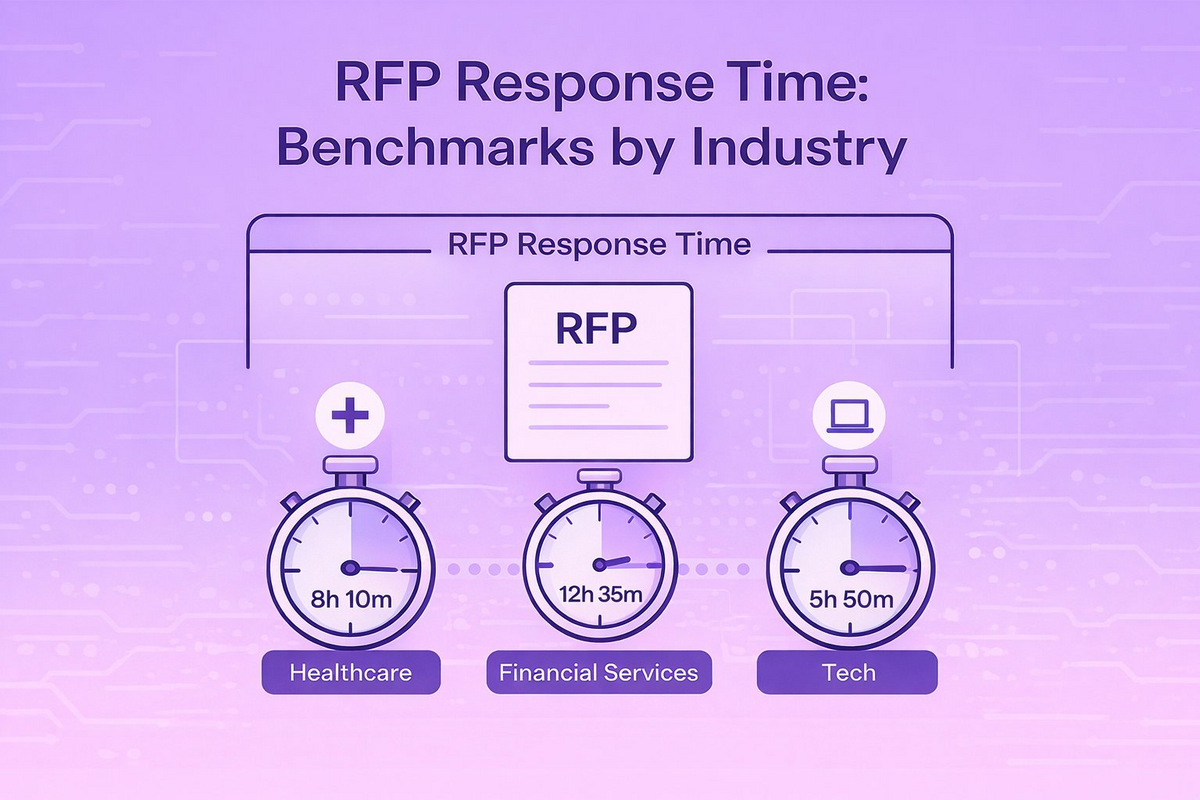

Ever wonder what a good RFP response time actually is? The truth is, it varies. A lot. Your industry, the deal size, and your team’s maturity all shape the timeline. Without knowing the benchmarks, you’re flying blind—setting unrealistic goals and missing chances to improve. This guide gives you the data you need. We'll look at response times across different sectors and show you exactly what the fastest teams do to win. It’s about working smarter, not just faster.
Why RFP Response Time Matters
Speed kills deals in both directions. Respond too slowly, and you miss deadlines or submit rushed, low-quality proposals. Respond efficiently, and you have time for strategic customization that wins business. The data shows that teams with faster baseline response times win more deals, not because speed itself impresses buyers, but because efficiency creates capacity for quality.
Research from proposal management professionals indicates that organizations spending less time on administrative tasks and more time on strategic response customization see win rates 15-25% higher than peers. The goal isn't just speed; it's efficiency that enables quality. When your team isn't buried in content searches and formatting, they can focus on what actually wins deals: understanding buyer needs and demonstrating unique value.
Response time also signals organizational capability to buyers. When you deliver comprehensive, accurate responses quickly, it demonstrates the operational excellence buyers want in a long-term partner. Conversely, scrambling to meet deadlines or requesting extensions raises concerns about your ability to execute after the contract is signed.
The True Cost of Manual RFP Responses
When you think about the cost of responding to an RFP, you probably focus on the hours your team spends writing and editing. But the true cost runs much deeper. Manual processes don't just consume time; they drain resources, lower morale, and directly impact your ability to win. It's a cycle of inefficiency where the administrative burden of finding information and managing versions overshadows the strategic work of crafting a compelling proposal. This heavy lift often leads to rushed, generic submissions that fail to stand out, or worse, missed deadlines that take you out of the running completely.
Effort and Time Statistics
If your team is responding to RFPs by hand, you already know it’s a marathon, not a sprint. The process can easily stretch across several weeks, with the majority of that time spent on tasks that happen long before anyone starts writing. Think about all the hours dedicated to hunting down the right information, chasing subject matter experts for answers, and manually compiling documents. Across different industries, the typical manual RFP response times are telling: a response for a medium-sized construction project can take at least two weeks, while a complex insurance RFP might demand six to ten weeks of focused effort. This extensive upfront labor is where teams lose momentum and valuable time that could be spent on strategy and customization.
Impact on Win Rates
The connection between response efficiency and winning deals is undeniable. Research shows that organizations that reduce time spent on administrative tasks see win rates 15-25% higher than their peers. This isn't because speed alone is the goal, but because efficiency creates the space for quality. When your team isn't bogged down by manual work, they can focus on tailoring the proposal to the buyer's specific needs and showcasing your unique value. In a competitive market, companies often lose bids not because their solution is inferior, but because their slow process leads to a rushed, generic response. This inefficiency doesn't just risk the deal; it can also lead to wasted resources and lower team morale.
Understanding the Buyer's RFP Process
To master your response strategy, you first need to walk a mile in the buyer's shoes. The Request for Proposal (RFP) isn't just a document that lands in your inbox; it's a critical step in a much larger, often complex, internal process for the purchasing organization. When you understand their journey, their timelines, and the pressures they face, you can tailor your response to not only meet their requirements but also to make their lives easier. This empathy is a secret weapon, turning you from just another vendor into a potential partner who truly gets it.
What is a Request for Proposal (RFP)?
At its core, an RFP is a formal document that a company uses to solicit detailed bids from potential vendors for a specific project or service. Think of it as structured problem-solving. The buyer has a need, and they're looking for the best possible partner to help them solve it. The RFP process allows them to compare apples to apples by asking the same set of questions to multiple suppliers. This ensures they can make an informed, objective decision based on factors like features, pricing, implementation, and support, rather than just going with the first option they find. It’s their way of doing due diligence on a significant purchase.
The Buyer's 10-Step Journey
Receiving an RFP means you're entering the buyer's world mid-story. Long before you were invited to bid, their team was busy identifying needs, getting stakeholder buy-in, defining project requirements, and securing a budget. The RFP is a major milestone for them, but it's just one part of a meticulous journey. After they receive your proposal, they still have to evaluate all submissions, create a shortlist, conduct demos, check references, and negotiate a contract. This process is essential for high-value projects because it helps them make smart decisions and avoid rushing into a bad partnership. Understanding this bigger picture helps explain the rigid deadlines and detailed questions they present.
Typical RFP Timelines by Project Complexity
The time it takes a buyer to move through the RFP process, from issuance to contract signing, depends heavily on project complexity. For a simple project, like renewing a software contract, the entire cycle might only take two to four weeks. A medium-complexity project, such as a custom software build, typically runs from four to eight weeks. For large, complex undertakings like an enterprise-wide system implementation, especially in regulated industries, you can expect the process to last anywhere from eight to sixteen weeks, or even longer. Knowing these general timelines helps you manage your own team's expectations and allocate resources more effectively for the long haul.
The Risks of Buyer-Side Delays
While it’s easy to get frustrated by a buyer's slow pace, remember that delays hurt them, too. A stalled decision-making process can lead to significant internal costs, missed business opportunities, and a serious case of project fatigue for their team. Every week they spend deliberating is another week they aren't solving the problem they issued the RFP for in the first place. This is where an efficient, clear, and comprehensive proposal from your team can be a game-changer. By providing an easy-to-evaluate response, you aren't just selling your solution; you're helping them accelerate their own success and demonstrating that you're an efficient, reliable partner from day one.
RFP Response Time Benchmarks by Industry
Response times vary significantly across industries due to differences in RFP complexity, compliance requirements, and typical deal sizes. Here's what the data shows across major sectors:
Technology and SaaS
Average response time: 15-25 hours of actual work across 2-3 weeks calendar time. Technology RFPs typically include 50-150 questions covering product capabilities, integrations, security, and implementation. Top-performing teams complete responses in 8-12 hours by leveraging content libraries and AI assistance. The security questionnaire component often adds 5-10 hours for enterprise deals.
Financial Services
Average response time: 30-50 hours across 3-4 weeks. Financial services RFPs are among the most demanding due to regulatory requirements, compliance documentation, and risk assessment sections. Due diligence questionnaires often accompany RFPs, adding significant effort. Firms with mature compliance content libraries reduce this to 20-30 hours.
Healthcare and Life Sciences
Average response time: 25-40 hours across 3-4 weeks. HIPAA compliance, clinical workflow requirements, and integration complexity drive longer timelines. Organizations with pre-approved compliance content and clinical use case documentation respond 40% faster than those building responses from scratch.
Government and Public Sector
Average response time: 40-80 hours across 4-6 weeks. Government RFPs are notoriously detailed, with strict formatting requirements and extensive compliance sections. The structured nature actually helps prepared teams: once you have compliant templates and approved content, much of the work becomes assembly rather than creation.
Professional Services
Average response time: 20-35 hours across 2-3 weeks. Professional services RFPs focus heavily on methodology, team qualifications, and case studies. The custom nature of services means more original writing per response, but smaller question counts partially offset this.
→ See how teams cut response time by 70%
Factors That Impact Response Time
RFP Complexity and Question Count
The most obvious factor is sheer volume. A 50-question RFP takes less time than a 200-question enterprise assessment. But question count alone doesn't tell the full story. Ten open-ended questions about implementation methodology may require more effort than fifty yes/no compliance checkboxes. Assess complexity by counting questions that require original writing versus those answerable from existing content.
Average Document Length and Structure
Beyond the question count, the sheer length of the final document is a major factor. While some responses are just a few pages, complex public sector bids can be massive—the average proposal is 144 pages. The challenge is to be thorough without overwhelming the evaluators, who always prefer a concise response. This is why a clear, organized structure is non-negotiable. Most winning proposals follow a standard format that mirrors the RFP itself, typically including a cover letter, executive summary, detailed answers to questions, an implementation plan, and pricing. Adhering to this structure makes your proposal easier to review and demonstrates a respect for the buyer's time, which can be a subtle but powerful advantage.
Content Library Maturity
Teams with mature content libraries achieve 60-70% reuse rates, meaning only 30-40% of each response requires new writing. Teams without organized content essentially start from scratch each time, multiplying effort by 2-3x. The investment in building and maintaining a content library pays dividends on every subsequent RFP.
SME Availability and Collaboration
Subject matter expert bottlenecks often determine response timeline more than actual writing effort. When technical, security, or legal experts are unavailable, responses stall. High-performing teams pre-approve content for common questions, reducing SME involvement to exception handling rather than routine drafting.
Tool Capabilities
Request for proposals software dramatically impacts response time. Teams using AI-powered platforms report 50-70% time savings compared to manual processes. The right tools automate content retrieval, enable parallel collaboration, and ensure consistency without manual checking.
Related: Explore RFP software capabilities
Common Mistakes That Hurt Your Win Rate (and Your Timeline)
Knowing the benchmarks is one thing; hitting them is another. Even with the best intentions, teams often fall into traps that extend timelines and weaken their proposals. Speed is a byproduct of an efficient process, not the primary goal. The real objective is creating a high-quality, customized response that wins. When your team isn't buried in content searches and formatting, they can focus on what actually wins deals: understanding buyer needs and demonstrating unique value. Avoiding these common mistakes is the first step toward building a more effective and efficient response process that gives you the time you need to focus on strategy.
Failing to Create "Win Themes"
A win theme is the central message that answers the buyer's unspoken question: "Why should we choose you over everyone else?" It’s the narrative thread that connects your solution directly to their biggest challenges and goals. Too many teams jump straight into answering questions without first defining this core story. Without a clear win theme, your proposal becomes a collection of facts instead of a compelling argument. A strong theme, woven throughout the document, shows you’ve done your homework and are presenting a thoughtful, strategic solution, not just a product list. This is where efficiency creates a competitive edge; less time on administrative tasks means more time for strategic thinking.
Using Generic, One-Size-Fits-All Answers
Buyers can spot a generic, copy-pasted response from a mile away. While leveraging a content library is essential for speed, the goal is to use pre-approved content as a starting point, not the final word. Customizing responses to reflect the buyer's specific language, industry, and stated problems is crucial. This shows you've listened and understand their unique context. For example, instead of just describing a feature, explain how that feature solves a specific problem mentioned in the RFP. A smart AI-powered platform can help you find the best baseline answer quickly, giving you more time to personalize it for maximum impact.
Ignoring Scoring Criteria and Mandatory Requirements
RFPs often include a scoring matrix or a list of mandatory requirements. Ignoring these is like trying to take a test without reading the instructions—you’re setting yourself up for failure. Missing a single mandatory "yes/no" answer can lead to immediate disqualification, no matter how great the rest of your proposal is. Delivering a comprehensive, accurate response demonstrates the operational excellence buyers look for in a long-term partner. A meticulous review process, supported by clear workflows and collaboration tools, ensures every box is checked and every point is accounted for, signaling to the buyer that you are a reliable and detail-oriented partner.
Confusing an RFP with an RFQ
This mistake can derail your entire effort before it even begins. While the acronyms are similar, their purposes are distinct. A Request for Quotation (RFQ) is primarily about price; the buyer knows what they want and is looking for the best deal. A Request for Proposal (RFP), on the other hand, is a request for a complete solution. The buyer has a problem and is looking for a partner with a strategic plan to solve it. Responding to an RFP with just a price list is a surefire way to lose. Understanding the buyer's intent helps you frame your entire response correctly, focusing on value and partnership rather than just cost.
Is the RFP Process Becoming Obsolete?
You might hear chatter about the RFP process being outdated, but it’s not going away. The need for a structured, fair evaluation process for complex purchases is as strong as ever. What *is* becoming obsolete is the old way of responding to them: the chaotic, manual scramble that burns out teams and produces mediocre results. The process is evolving, and buyers' expectations are changing with it. They expect faster, more relevant, and highly personalized responses. The pressure is on sellers to adapt their methods to meet this new standard of efficiency and quality.
This is where technology is fundamentally reshaping the landscape. Teams using AI-powered RFP software report significant time savings—often between 50-70%—compared to manual processes. This isn't about replacing human expertise; it's about augmenting it. AI handles the repetitive, time-consuming tasks like searching for past answers, formatting documents, and flagging outdated content. This frees up your proposal managers and subject matter experts to focus on high-value activities: tailoring content, developing win themes, and building a compelling business case. The RFP isn't dead; it's just demanding that we work smarter, not harder.
How Top Teams Achieve Faster Response Times
1. Invest in Content Infrastructure
Elite teams treat their content library as a strategic asset. They assign ownership for each content area, establish review cycles to keep information current, and tag content for easy retrieval. This upfront investment reduces per-RFP effort dramatically. A well-maintained library of 500-1,000 pre-approved responses covers 60-80% of typical RFP questions.
2. Implement Tiered Review Processes
Not every question needs executive review. Top teams categorize questions by risk and complexity, routing only high-stakes items to senior reviewers. Standard questions use pre-approved content with minimal oversight. This reduces bottlenecks while maintaining quality where it matters most.
3. Leverage AI for First Drafts
AI-powered drafting transforms the response process. Instead of starting with blank pages, teams begin with AI-generated first drafts based on their approved content. Human effort shifts from writing to reviewing and refining, cutting time by 50% or more while often improving quality through consistent use of best content.
4. Parallelize Work Streams
Sequential processes create unnecessary delays. When one person drafts while others wait, response time extends unnecessarily. Modern collaboration tools enable multiple team members to work simultaneously on different sections, compressing calendar time even when total effort remains similar.
5. Establish Go/No-Go Discipline
Paradoxically, saying no to some RFPs improves response time on others. When teams pursue every opportunity regardless of fit, resources spread thin and quality suffers across the board. Disciplined qualification ensures your best effort goes toward winnable opportunities.
→ Book a demo to improve your response metrics
Measuring and Improving Your Response Time
You can't improve what you don't measure. Track these metrics to understand your current state and identify improvement opportunities:
Total hours per RFP measures actual effort invested. Track time by phase: planning, drafting, review, and finalization. This reveals where effort concentrates and where improvements will have the most impact. Most teams find that content search and initial drafting consume 60-70% of total time, making these phases prime targets for automation.
Calendar time from receipt to submission shows end-to-end cycle time including delays and handoffs. Even if actual work hours are reasonable, long calendar times suggest bottlenecks, availability issues, or process inefficiencies worth addressing.
Content reuse rate indicates library maturity. Calculate the percentage of response content that comes from pre-approved sources versus new writing. Rates below 50% suggest significant opportunity to build your library. Rates above 70% indicate a mature operation.
SME time per RFP reveals expert bottlenecks. If subject matter experts spend hours on every RFP, your content library likely lacks approved answers for their domains. Building that content frees experts for higher-value work.
Related: Learn about RFP analytics and reporting
Frequently Asked Questions
What's a good target for RFP response time?
For most technology and professional services RFPs, target 10-15 hours of actual work time. Enterprise and government RFPs with extensive compliance requirements may require 20-30 hours. If you're consistently above these benchmarks, there's significant room for improvement through better content management and tooling.
How much can AI reduce response time?
Organizations implementing AI-powered RFP tools report 50-70% reductions in response time. The impact depends on content library quality and RFP complexity. AI excels at matching questions to existing content and generating first drafts, which typically consume the majority of manual effort.
Does faster response time improve win rates?
Indirectly, yes. Speed itself doesn't impress buyers, but the efficiency that enables speed creates capacity for quality. Teams that spend less time on administrative work can invest more in strategic customization, competitive positioning, and executive summaries that actually influence decisions.
How do we benchmark against competitors?
Direct competitor benchmarking is difficult since response times aren't public. Focus on your own improvement trajectory and industry benchmarks. If you're completing responses significantly faster than timelines buyers provide, you're likely competitive. Use recovered time for quality improvements rather than earlier submission.
What's the ROI of reducing response time?
Calculate ROI by multiplying hours saved per RFP by your team's blended hourly cost, then by annual RFP volume. A team handling 50 RFPs annually that saves 10 hours each at $100/hour recovers $50,000 in capacity. Additional value comes from handling more opportunities and improving win rates through better quality.
Taking Action on Response Time
Improving RFP response time requires investment in content, process, and tools. Start by measuring your current state to establish baselines. Identify the biggest time sinks through phase-level tracking. Then address root causes systematically: build content libraries, streamline reviews, and implement appropriate technology.
The teams that respond efficiently to RFPs gain compound advantages. They handle more opportunities without adding headcount. They have time for the customization that wins competitive deals. And they demonstrate operational excellence that buyers value in long-term partners.
→ See how Iris helps teams respond faster
Related: Read customer success stories
Key Takeaways
- Efficiency creates quality: A faster response process isn't about submitting early; it's about creating more time for strategic work. Use the hours you save to customize your proposal and develop compelling win themes that directly address the buyer's needs.
- Measure your process to find bottlenecks: Understand industry benchmarks to set realistic goals, then track your own metrics to find what's slowing you down. The biggest time sinks are often disorganized content libraries and waiting for subject matter experts.
- Leverage technology for strategic focus: Implementing RFP software automates the most repetitive tasks, like finding answers and formatting documents. This shifts your team's focus from administrative work to the high-impact personalization that actually wins deals.
Related Articles
Share this post
Link copied!







_EasiestToDoBusinessWith_EaseOfDoingBusinessWith.svg)
_HighPerformer_HighPerformer.svg)





_BestSupport_QualityOfSupport.svg)


