
What is a BAFO? A Guide to Winning the Deal
February 3, 2026
By
Evie Secilmis
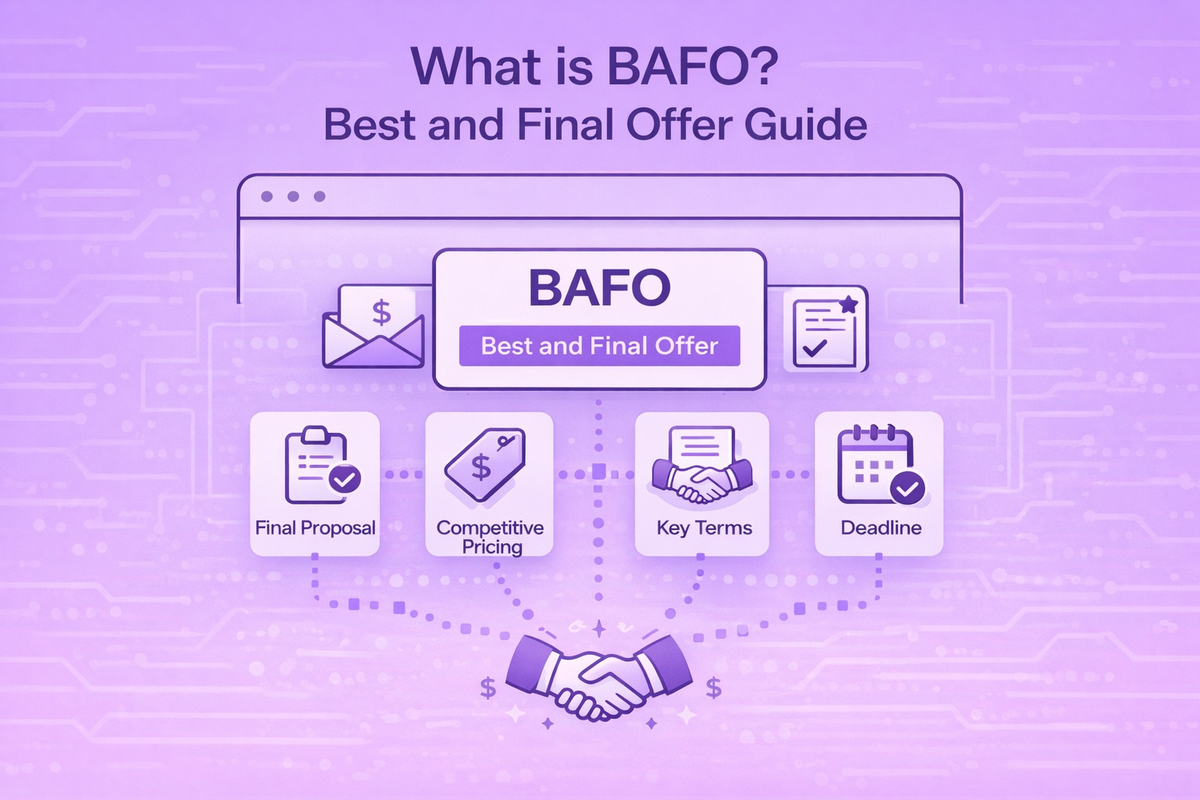

You’ve spent weeks on a proposal, poured resources into your response, and finally hit send. Just when you think the hard part is over, an email lands in your inbox: “We’d like to invite you to submit a Best and Final Offer.” This is both a good sign and a moment of intense pressure. It means you’re a top contender, but it also confirms your initial bid wasn’t quite enough. So, what is BAFO, really? It's more than just a price cut; it's a strategic test. This guide breaks down the true BAFO meaning and how to craft a response that wins.
This BAFO request signals you're in the final running—but also that your initial proposal didn't quite hit the mark. What you do next can make or break the deal. Understanding how to respond strategically to BAFO requests gives vendors a competitive edge in high-stakes procurement processes.
What is a BAFO (Best and Final Offer)?
BAFO stands for "Best and Final Offer." It's a procurement stage where buyers ask shortlisted vendors to submit revised proposals, typically with improved pricing, refined solution details, or both. The BAFO represents your last opportunity to strengthen your position before the buyer makes a final selection.
The term is most common in government procurement and large enterprise purchases where formal competitive bidding processes govern vendor selection. Federal contracts often require BAFO rounds as part of structured procurement regulations. However, commercial buyers increasingly use BAFO processes for complex purchases where initial proposals leave room for negotiation.
The BAFO serves multiple purposes for buyers. It creates competitive pressure that often results in better pricing and terms. It allows buyers to request clarifications or adjustments based on initial evaluation. It provides a clear endpoint to the procurement process, preventing endless negotiation rounds. For vendors, understanding the strategic implications of a BAFO request is crucial for maximizing win probability.
When buyers issue BAFO requests, they're typically narrowed the field to 2-3 finalists. Making this shortlist is an achievement—you've demonstrated capability and fit. But it also means competition is fierce among highly qualified vendors. Your proposal response strategy needs to be sharpened for this final round.
The Formal BAFO Process: A Buyer's Perspective
To craft a winning BAFO, you first need to understand why the buyer requested it. From their side of the table, the BAFO is a powerful tool. After reviewing initial proposals, they have a solid grasp of the market and the available solutions. Now, they want to sharpen the details. The BAFO process creates competitive pressure, encouraging the final few vendors to put their most attractive pricing and terms forward. It’s also the buyer’s chance to request clarifications on specific points from your initial bid, ensuring they can make a true apples-to-apples comparison before making a decision. Think of it less as a rejection of your first offer and more as a final, focused interview for the job.
From Initial Bids to Final Selection
The BAFO stage doesn't happen in a vacuum. It’s a specific step that follows the initial proposal review. Typically, a buyer will evaluate all the RFP responses they’ve received, weighing them against their predefined criteria for cost, technical solution, and vendor qualifications. From that pool, they select a shortlist of the most promising suppliers—usually just two or three. These are the vendors who receive the invitation to submit a Best and Final Offer. Getting this request means you’ve already cleared several hurdles and are considered a top contender. The buyer is now looking for the definitive offer that will seal the deal.
The Binding Nature of a BAFO
This is the most critical aspect to understand: your Best and Final Offer is exactly that—final. Once submitted, it’s generally considered a binding commitment. Unlike earlier negotiation rounds where terms might be fluid, the BAFO is a firm agreement that your company must be prepared to honor if selected. This means there’s no room for error or last-minute changes. Every number, term, and condition you include must be carefully vetted and approved internally. This is where having a centralized source of truth for your proposal content is invaluable, as it ensures the information you submit is accurate and something your entire organization can stand behind. The stakes are high, and the buyer expects you to stick to your offer without further negotiation.
Why Buyers Ask for a Best and Final Offer
Understanding when and why buyers request BAFOs helps vendors prepare effectively.
Competitive Pricing Pressure
The most common BAFO trigger is pricing. Initial proposals reveal a price range across vendors, but the buyer believes further optimization is possible. By requesting BAFOs, the buyer signals that pricing is a critical factor and creates pressure for vendors to sharpen their pencils.
This doesn't mean the buyer is only focused on price. Often, they want to see how low vendors will go while maintaining the proposed solution scope. Vendors who cut price by eliminating valuable features may actually weaken their position.
Solution Refinement Needed
Sometimes initial proposals nearly meet requirements but need adjustment. Perhaps the implementation timeline doesn't align with the buyer's constraints. Maybe certain technical specifications need clarification. The BAFO round allows vendors to refine solutions based on buyer feedback.
Smart buyers provide specific guidance about what they'd like to see improved in the BAFO. This might include integration requirements, support levels, training scope, or delivery schedules. Vendors who address these specific points demonstrate they're listening and flexible.
Compliance or Requirement Gaps
Initial evaluation may reveal that top proposals have minor compliance issues or don't fully address certain requirements. Rather than disqualifying otherwise strong vendors, buyers use the BAFO round to give them an opportunity to resolve these gaps.
This is particularly common in complex government RFPs where requirements run to hundreds of pages. A vendor might have missed a minor specification or provided insufficient detail on a particular capability. The BAFO request gives them a chance to complete their response.
Final Due Diligence
For high-value or strategic purchases, buyers may request BAFOs as part of thorough due diligence even if initial proposals were strong. This might include requesting additional financial information, detailed implementation plans, or enhanced contract terms.
The buyer wants absolute confidence before making a final commitment, especially for partnerships involving millions of dollars or multi-year commitments. Understanding procurement processes helps vendors anticipate these requests and prepare documentation in advance.
When Initial Bids Are Too Close to Call
Sometimes, a buyer reviews initial proposals and finds themselves in a tough spot. Two or three vendors have submitted excellent, nearly identical bids where the solutions meet all key requirements, the pricing is competitive, and each company seems like a strong partner. In this situation, the BAFO serves as the ultimate tie-breaker. It’s the buyer’s way of asking the top contenders, “What else have you got?” This final round isn't just about a price drop; it's a test of agility and commitment. The buyer is looking for the partner who is most invested and can demonstrate superior value under pressure, forcing finalists to refine their offers and prove they are the absolute best choice for a long-term partnership.
Winning this final round often comes down to the details. The buyer might seek a slightly better price, but they also test for responsiveness by requesting minor adjustments to the implementation plan or clarification on a service-level agreement. How quickly and accurately you respond is critical, as it signals how you'll operate as a partner. When you need to pull precise details for a last-minute refinement, having a system that can generate accurate proposals quickly is a significant advantage. The vendor who can confidently provide the most compelling and well-documented final offer under a tight deadline is the one who often comes out on top.
Key Questions to Ask Before Submitting Your BAFO
The BAFO round requires careful strategic thinking. Don't simply slash prices and resubmit.
Understand Your Position
The fact that you received a BAFO request tells you something important: you're competitive but not the clear winner. Try to understand where you stand relative to competitors.
If the buyer provided feedback or clarifying questions with the BAFO request, analyze it carefully. What aspects are they questioning? What did they ask you to clarify that they probably didn't ask competitors? This reveals potential weaknesses in your initial proposal.
Sometimes buyers explicitly state evaluation results: "You're our second choice on technical merit but first on price," or vice versa. This intelligence is gold—it tells you exactly what to strengthen in your BAFO. More often, you'll need to infer your position from the types of questions asked and adjustments requested.
Assess Price Reduction Feasibility
Before cutting prices, run the numbers realistically. What can you actually deliver profitably at a lower price point? Where can you find efficiencies without sacrificing quality or margin?
Common levers include reducing implementation scope, adjusting service levels, modifying payment terms, or extending delivery timelines. Each involves tradeoffs. Cutting implementation scope might lower costs but also reduce solution value. Extending timelines might enable resource sharing across projects but could conflict with the buyer's launch requirements.
Avoid the trap of bidding unprofitably to win. You'll regret that decision through years of a difficult engagement. If you're already at your floor price, don't go lower—strengthen value instead. Effective proposal strategies focus on demonstrating value, not just cutting price.
Identify Value-Add Opportunities
Instead of only cutting price, consider what additional value you could offer. This might include extended warranties, additional training, enhanced support, or complementary services. These additions cost you less than their perceived value to the buyer, creating win-win scenarios.
Think about the buyer's broader goals beyond the immediate purchase. Are they trying to build internal capability? Offer knowledge transfer and training. Concerned about implementation risk? Propose more robust project management or phased approaches with early wins. Worried about long-term support? Enhance your maintenance and support offering.
Value-add approaches often work better than pure price reduction because they demonstrate you understand the buyer's needs and are invested in their success—not just winning the contract.
Sometimes the right move is not submitting a BAFO at all. If the buyer's expectations are unrealistic, the project is unprofitable at required price points, or fit is poor, declining to submit a BAFO preserves resources for better opportunities.
Declining gracefully maintains relationships for future opportunities. A brief message explaining that after careful consideration, you don't believe you can meet the buyer's needs at an acceptable price point is better than submitting a half-hearted BAFO or accepting an unprofitable engagement.
This decision requires honest internal assessment. Involve finance, delivery teams, and executive leadership. Don't let sales optimism override practical considerations.
How to Write a BAFO That Wins the Deal
A strategic BAFO goes beyond adjusting numbers. It requires thoughtful positioning and clear communication.
Address Buyer Feedback Directly
If the buyer provided specific feedback or questions with the BAFO request, address every point explicitly. Don't make them hunt for answers. Use a clear structure that maps to their questions.
Create a summary section at the beginning of your BAFO that directly responds to each point raised. "You asked about X—here's how we've addressed it in this BAFO." This shows you're responsive and makes evaluation easier.
For technical questions or requirement clarifications, provide detailed answers with supporting documentation. If you initially under-explained a capability, now is the time to elaborate fully.
Justify Price Changes Clearly
If you're reducing price, explain what changed. Did you find efficiencies in delivery? Adjust scope? Modify terms? Buyers are suspicious of significant price drops without clear justification—it suggests initial pricing was inflated or the quality will suffer.
A transparent explanation builds trust: "Our revised pricing reflects a modified implementation approach that reduces onsite time from 200 to 150 hours while maintaining all required functionality. This is achieved by leveraging remote capabilities and conducting more training through video conference."
If you're holding price steady or increasing it (perhaps by adding requested features), justify that clearly too. Show how the value proposition strengthens: "While our pricing remains unchanged, we've enhanced the solution by adding X and Y capabilities that directly address the requirements you highlighted."
Strengthen Weak Areas
Use the BAFO round to shore up any weaknesses identified during initial evaluation. If your implementation timeline was longer than competitors, can you accelerate it? If your team's industry experience was questioned, can you add specific industry specialists?
This requires honest assessment of where your initial proposal fell short. Review any feedback provided, analyze questions asked, and think about what might have concerned evaluators. Then address those concerns directly in your BAFO.
Don't ignore weaknesses hoping evaluators forgot about them. They didn't. Address concerns head-on with specific solutions.
Reinforce Differentiators
While addressing weaknesses, don't lose sight of your strengths. Reinforce whatever makes your solution unique or superior. If you have the strongest technology, emphasize it. If your team's experience is unmatched, highlight it. If your customer success track record is exceptional, showcase it.
Case studies and customer references become particularly valuable in the BAFO round. Concrete examples of how you've delivered similar projects successfully for comparable customers provide powerful proof points.
Balance is key—address weaknesses while reinforcing strengths. The goal is a comprehensive response that makes you the obvious choice.
Polish Presentation Quality
Your BAFO should be more polished than your initial proposal, not less. This is your final impression. Invest in clear writing, professional formatting, and thorough proofreading.
Buyers often evaluate multiple BAFO submissions back-to-back. A well-organized, clearly written BAFO is easier to evaluate and reflects professionalism. Conversely, a rushed, poorly formatted submission suggests you don't take the opportunity seriously.
AI-powered proposal tools can accelerate BAFO preparation by quickly pulling together relevant content, generating responses to new questions, and ensuring consistency across sections—allowing your team to focus on strategy and positioning rather than formatting and document wrangling.
What to Include in Your BAFO Submission
Your BAFO submission is a comprehensive package, not just a revised price list. It should be a complete, standalone document that finalizes every aspect of your offer. This is your last chance to present a compelling case, so every detail matters. The buyer will use this document to make their final decision, comparing it directly against the other finalists' submissions. Make sure it’s easy for them to see the improvements you’ve made and understand the full value you bring to the table. A well-structured BAFO addresses all the buyer's explicit and implicit concerns, leaving no room for ambiguity.
Revised Pricing and Timelines
The BAFO represents your last opportunity to strengthen your position before the buyer makes a final selection. This is where you put your most competitive pricing forward, but it must be a number your business can stand behind profitably. If you’re adjusting your price, provide a clear rationale. For example, you might explain that you’ve identified efficiencies in your delivery model or are offering a multi-year discount. Similarly, any changes to the project timeline should be detailed. Perhaps you can expedite implementation to meet a critical deadline for the buyer, or maybe a phased rollout would be more practical. Whatever you propose, make sure it’s realistic and aligns with the buyer’s stated goals.
Finalized Terms and Conditions
Beyond the numbers, your BAFO must lock in all contractual details. This includes payment terms, service level agreements (SLAs), support packages, and any other legal stipulations. Smart buyers provide specific guidance about what they'd like to see improved in the BAFO, which might include integration requirements, support levels, or training scope. Your ability to respond flexibly to these requests demonstrates that you are a true partner, not just a vendor. Using a centralized knowledge base, like the one within the Iris platform, ensures that all your proposed terms are consistent, pre-approved, and aligned with your company's standards, preventing last-minute internal scrambles.
Understanding the Evaluation Criteria Beyond Price
While pricing is almost always a major factor in a BAFO, it's rarely the only one. The lowest bid doesn't automatically win, especially in complex B2B sales. Buyers are making a strategic investment and are looking for the best overall value, not just the cheapest option. They are evaluating risk, long-term viability, and the quality of the partnership. Vendors who focus solely on slashing their price often miss the opportunity to reinforce their strengths in other critical areas. Understanding the buyer's broader evaluation criteria allows you to craft a BAFO that highlights your solution's total value proposition.
Total Cost of Ownership
Experienced buyers look at more than just the lowest price; they consider the total cost of ownership (TCO). TCO includes the initial price of the product or service, plus all associated setup costs, implementation fees, training expenses, and ongoing maintenance or subscription fees. A solution with a higher upfront cost might have a lower TCO if it requires less maintenance or includes more comprehensive support. When you build your BAFO, frame your pricing in these terms. Highlighting how your solution minimizes long-term costs can justify a higher initial price and show that you’ve considered the buyer’s budget over the entire lifecycle of the investment.
Service Level Agreements (SLAs) and Integration
Buyers want to see how low vendors will go while maintaining the proposed solution's scope. Vendors who cut prices by eliminating valuable features may actually weaken their position. This is where non-financial elements like SLAs and integration capabilities become powerful differentiators. A strong SLA that guarantees uptime and rapid support response can provide peace of mind that’s worth a premium. Likewise, demonstrating seamless integration with the buyer's existing technology stack reduces their implementation risk and internal workload. Your BAFO should emphasize these value-adds, proving that your solution is not only cost-effective but also reliable and easy to adopt.
Common BAFO Challenges (and How to Handle Them)
Receiving a BAFO request is a great sign, but the final stretch is often the most challenging. The pressure is on, deadlines are tight, and a single misstep can cost you the deal. Navigating this stage successfully means anticipating the common hurdles and having a clear plan to address them. From deciphering vague feedback to working against the clock, here are some of the biggest challenges you might face and how to handle them with confidence.
Working with Tight Deadlines
Buyers rarely give you much time to turn around a BAFO. This compressed timeline can create chaos, forcing your team to rush and potentially make mistakes. The biggest danger is defaulting to a simple price cut without thinking through the strategic implications for profitability and delivery. To counter this, your response process needs to be agile. Having a centralized, up-to-date content library is a game-changer, allowing you to pull approved answers and data instantly. This is where an AI deal desk solution can make all the difference, helping you generate a high-quality first draft in minutes, not days.
A tight deadline also forces a critical decision: whether to respond at all. Sometimes, the best strategic move is to politely decline. If the buyer’s revised expectations are unrealistic, the project would be unprofitable at the required price, or you uncover a poor fit, walking away is a valid choice. It preserves your team’s time and resources for opportunities that are a better match. Your proposal response strategy should always include knowing when to say no, allowing you to focus your energy on deals you can and should win.
Misinterpreting Buyer Feedback
The feedback or questions accompanying a BAFO request are your roadmap, but they can sometimes feel like a riddle. Misinterpreting what the buyer truly wants is a common pitfall. They might ask for a lower price, but what they’re really looking for is a more flexible payment schedule or a different service tier. Reading between the lines is key. If their questions are heavily focused on your implementation process, that’s likely where their biggest concerns lie, even if they also mention budget. Your BAFO needs to address these underlying anxieties, not just the surface-level requests.
When you receive feedback, your first step should be to address every single point directly and explicitly. Don't bury your answers in a dense document or force the evaluation committee to search for them. A great approach is to create a summary table or a dedicated section in your BAFO that mirrors their questions and provides clear, concise responses. This demonstrates that you’ve listened carefully and are responsive to their needs. It makes their job easier and shows that you would be a collaborative and attentive partner, which can be a powerful differentiator in the final decision.
BAFO Mistakes That Could Cost You the Deal
Learn from others' errors to strengthen your own BAFO responses.
Slashing Price Without Strategic Rationale
The most common mistake is dramatic price reduction without clear justification. Buyers wonder: "If you could deliver at this price, why didn't you initially? Are you desperate? Will quality suffer?"
Price reductions above 10-15% without corresponding scope changes or efficiency explanations raise red flags. If you need to reduce price significantly, explain exactly what changed—delivery approach, resource allocation, payment terms, or scope modifications.
Failing to Address Feedback
If the buyer specifically requested clarification or changes, not addressing those points thoroughly is a fatal error. It signals you're not listening or can't meet requirements.
Create a checklist of every point raised in the BAFO request and verify your response addresses each one explicitly. Don't assume evaluators will find answers buried in your document—make them obvious.
Making Unsubstantiated Claims
Don't claim capabilities you can't demonstrate or promise delivery you can't guarantee. The BAFO round involves closer scrutiny. Buyers often request references, proof points, or demonstrations for claims made in BAFOs.
If you claim faster implementation, show exactly how. If you assert superior technology, provide evidence. If you promise exceptional support, offer to connect buyers with current customers. Substantiate everything.
Submitting Late
BAFO deadlines are typically firm because buyers want to maintain procurement schedules. Late submissions may not be accepted at all, or will face penalties in evaluation.
Work backward from the deadline to establish internal milestones. Account for executive approval, legal review, and quality control. Better to submit a strong BAFO one day early than an imperfect one right at deadline.
Over-Engineering the Response
While thoroughness is important, don't overwhelm evaluators with excessive detail. The BAFO should be comprehensive but concise—focused on addressing the specific questions and improvements requested rather than restating everything from your initial proposal.
Summarize key points clearly, then provide supporting detail in appendices. Make it easy for evaluators to find what they need without wading through hundreds of pages.
You've Submitted Your BAFO. Now What?
The work doesn't end when you submit.
Prepare for Negotiations
Even after BAFO submission, buyers may request final negotiations or clarifications. Be ready to respond quickly to additional questions or requests for live presentations demonstrating capabilities.
Have your subject matter experts available and briefed. Prepare talking points for likely discussion topics. Review your BAFO thoroughly so everyone on your team understands what was committed.
Plan for Multiple Scenarios
Prepare for different outcomes. If you win, what needs to happen immediately to kick off the project successfully? If you lose, how will you maintain the relationship for future opportunities? If the buyer wants to negotiate further, what's your flexibility?
Having these plans ready accelerates response regardless of outcome. Winners who can mobilize immediately demonstrate professionalism and preparedness. Gracious losers who seek feedback and maintain relationships often win next time.
Document Lessons Learned
Regardless of outcome, document what worked and what didn't in your BAFO process. What price adjustments were feasible? What value-adds resonated? What questions or concerns emerged?
Knowledge management systems should capture these insights to improve future responses. Each BAFO experience teaches something about buyer priorities, competitive positioning, and effective proposal strategies.
Frequently Asked Questions
How is a BAFO used in procurement?
BAFO stands for "Best and Final Offer." It's a procurement term referring to the last round of proposal submissions before a buyer makes a final vendor selection. The BAFO gives shortlisted vendors one more opportunity to improve their proposals, typically through better pricing, refined solutions, or enhanced terms.
Should I reduce the price in my BAFO?
Analyze the buyer's feedback and your competitive position. If pricing was explicitly flagged as a concern or competitors likely bid lower, price reduction may be necessary. However, don't slash prices blindly—identify genuine efficiencies or scope adjustments that enable lower pricing while maintaining profitability. If you're already at your floor price, focus on adding value instead of reducing price.
Can I decline to submit a BAFO?
Yes, declining is sometimes the right strategic decision. If the opportunity is unprofitable at required price points, fit is poor, or buyer expectations are unrealistic, politely declining preserves resources for better opportunities. Maintain professionalism in your decline message to preserve the relationship for future opportunities.
How much time do you get to prepare a BAFO?
BAFO submission windows vary but typically range from 1-3 weeks depending on proposal complexity. Government contracts often specify minimum timeframes in regulations. Commercial buyers may provide shorter windows if they're moving quickly. The deadline is usually firm, so start immediately upon receiving the request.
What happens after all BAFOs are submitted?
Buyers evaluate final submissions against their requirements and selection criteria, often conducting final negotiations or clarifications with top vendors. They may request live demonstrations, reference checks, or financial verification. The process typically concludes with contract award to the selected vendor, though some buyers negotiate final terms even after selection.
Should I rewrite my entire proposal for the BAFO?
No, focus your BAFO on addressing specific feedback, improving weak areas, and justifying any pricing changes. Reference your initial proposal for unchanged sections rather than repeating everything. Evaluators want to see what's different and improved, not read the same proposal twice. Make changes clear and evaluation easy.
Your Next Steps to a Winning BAFO
BAFO rounds represent high-stakes final opportunities to win competitive procurements. Success requires balancing competitive pressure with profitability, addressing buyer feedback directly, and strengthening your value proposition strategically.
Organizations that approach BAFOs strategically—with clear understanding of competitive position, realistic assessment of pricing flexibility, and focus on demonstrating value—consistently outperform those who simply cut prices and hope for the best.
AI-powered knowledge management platforms like Iris help teams respond to BAFO requests faster by centralizing proposal content, generating responses to new questions, and maintaining consistency across complex documents—enabling strategic focus rather than administrative scrambling. See how technology can strengthen your competitive positioning.
Key Takeaways
- Think beyond the price drop: A BAFO is your final, binding chance to prove you are the best partner. Focus on adding strategic value, like better terms or extra services, instead of simply slashing your price.
- Read between the lines of the buyer's feedback: Their questions reveal your proposal's weak spots and your competitive standing. Use this insight to craft a realistic and profitable final offer that directly addresses their concerns.
- Justify every change with confidence: Your final submission should be a complete, polished document. Clearly explain the reasoning for any adjustments and reinforce your unique strengths to make the buyer's decision an easy one.
Related Articles
Share this post
Link copied!







_EasiestToDoBusinessWith_EaseOfDoingBusinessWith.svg)
_HighPerformer_HighPerformer.svg)





_BestSupport_QualityOfSupport.svg)


