
What is BOFU? Why It's Key to Closing Deals
February 10, 2026
By
Evie Secilmis


The bottom of the funnel is where sales and marketing alignment is truly put to the test. Marketing can generate thousands of leads, but if the sales team doesn't have the right content to close them, those efforts are wasted. This is the BOFU stage, where prospects need case studies, demos, and detailed proposals to make a final decision. When these two teams work in sync, the entire process becomes smoother and more effective, leading to higher conversion rates. This guide is for both marketers and sellers who want to build a powerful BOFU strategy that equips sales to win and proves marketing's direct impact on revenue.
What is BOFU?
BOFU stands for Bottom of Funnel—the final stage in the marketing and sales funnel where prospects are ready to make a purchasing decision. At this stage, potential customers have identified their problem (TOFU), evaluated potential solutions (MOFU), and are now comparing specific vendors or products to choose the best fit.
BOFU prospects aren't browsing—they're buying. They've done their research, narrowed their options, and need final validation before committing. The content, messaging, and experiences you provide at this stage directly influence whether they choose you or a competitor.
Think of the funnel like a journey:
- TOFU (Top of Funnel): Awareness—"I have a problem"
- MOFU (Middle of Funnel): Consideration—"What solutions exist?"
- BOFU (Bottom of Funnel): Decision—"Which solution should I buy?"
Each stage requires different content and approaches. BOFU demands specificity, proof, and confidence-building.
The Role of BOFU in the B2B Sales Funnel
In the B2B sales funnel, the BOFU stage is the final handshake before the deal is signed. This is where your most qualified leads land after they’ve done their homework. They understand their problem, have explored potential solutions, and are now comparing a handful of top contenders—including you. Your role shifts from general education to specific persuasion. The goal is to provide the final pieces of proof that make choosing your solution the obvious and most confident decision for their business. This is where you need to be ready for the tough, detailed questions that come with RFPs, security questionnaires, and due diligence documents.
The interactions at this stage are critical because they directly influence the final purchasing decision. Your prospect is looking for validation, comparing features, and assessing value. Every piece of content, from a detailed case study to a product demo, must be designed to build trust and eliminate any remaining doubt. For sales teams, this means delivering fast, accurate, and compelling responses that showcase not just what your product does, but how it solves their specific problem better than anyone else. It’s the last mile of the sales journey, and your performance here determines whether you win the business or watch it go to a competitor.
Why Focusing on BOFU Drives Sales
Connect Your Content Directly to Revenue
BOFU activities are closest to revenue. A well-optimized BOFU converts more prospects into customers without requiring additional top-of-funnel investment. Improving BOFU conversion from 20% to 30% increases revenue by 50% from the same pipeline.
Generate More (and Bigger) Sales-Ready Leads
The bottom of the funnel is where your most qualified leads live. These prospects have moved past general research and are actively evaluating vendors, meaning they have a high intent to buy. By concentrating your efforts here, you shift from a quantity-based approach to a quality-focused one. Your goal is to provide the final pieces of proof that make choosing your solution an easy decision. This is the time for high-touch, specific content like personalized demos, free trials, and compelling case studies that showcase real-world success. When a prospect is confident in your ability to solve their problem, they're more likely to commit to a larger deal. A thorough, fast, and accurate response to a detailed RFP, for instance, doesn't just win the business—it builds the trust needed for a more significant partnership from day one.
Stand Out from the Competition
At BOFU, prospects are actively comparing you to alternatives. This is where differentiation matters most. Generic messaging won't cut it—you need to clearly articulate why your solution is the right choice for their specific situation.
Get Sales and Marketing on the Same Page
BOFU is where marketing and sales most directly collaborate. Marketing creates the content and experiences that support sales conversations; sales provides feedback on what prospects need to make decisions. Misalignment here costs deals.
Attract Higher-Quality Leads
Strong BOFU qualification ensures you're attracting customers who genuinely fit your product. Weak BOFU that pushes everyone toward purchase creates churn problems downstream—customers who shouldn't have bought realize it too late.
TOFU, MOFU, and BOFU: What's the Difference?
Understanding how BOFU differs from earlier funnel stages helps you create appropriate content and experiences:
StageProspect MindsetContent GoalContent TypesTOFU"I have a problem"Educate, build awarenessBlog posts, guides, videosMOFU"What solutions exist?"Nurture, build considerationEbooks, webinars, comparisonsBOFU"Which vendor should I choose?"Convert, validate decisionCase studies, demos, trials
TOFU casts a wide net, attracting anyone with related interests. Content is educational and ungated.
MOFU narrows focus to prospects actively seeking solutions. Content demonstrates expertise and positions your approach.
BOFU targets prospects ready to buy. Content proves you can deliver results for customers like them.
The Modern Buyer's Journey: From Education to Purchase
The buyer's journey is the path a potential customer takes from first realizing they have a problem to making a final purchase. Think of it as a structured process that helps you create marketing and sales strategies that actually connect with people at the right time. By understanding where a prospect is in their journey, you can provide the exact information they need to move forward. This isn't just about pushing a sale; it's about guiding them toward the best solution for their needs, which builds trust and positions you as a helpful expert rather than just another vendor trying to close a deal.
Top of the Funnel (TOFU): Building Awareness
At the top of the funnel, or TOFU, your goal is to attract a wide audience and educate them about a problem they might not even know they have. As Lucidchart notes, this stage "casts a wide net, attracting anyone with related interests." The content here should be purely educational and easy to access—no forms, no gates. Think blog posts, informative guides, or short videos that address common pain points. For example, a prospect might search for "how to speed up sales proposals" and find your article on the topic. They aren't looking for your specific product yet; they're just trying to understand their challenge. This is your chance to generate leads by being the most helpful resource out there.
Middle of the Funnel (MOFU): Fostering Consideration
Once a prospect moves into the middle of the funnel (MOFU), they've defined their problem and are actively looking for solutions. Your job is to show them why your *type* of solution is the best approach. This is where you start to nurture the leads you attracted in the TOFU stage. The content becomes more specific and often requires an email address to access. Think ebooks, webinars, and detailed case studies that demonstrate your expertise. For instance, that same prospect who was just learning about proposal speed is now evaluating different methods—like using templates, hiring writers, or implementing AI software. Your MOFU content should guide them toward your category and prove its value.
What Kind of Content Actually Closes Deals?
Show, Don't Tell with Case Studies and Stories
Nothing validates your claims like proof from real customers. Effective case studies include:
- Customer context (industry, size, challenge)
- Specific results with numbers
- Implementation details
- Quotes from stakeholders
Match case studies to prospect profiles—a healthcare company wants to see healthcare examples; an enterprise wants enterprise proof points. See examples of effective case studies in Iris customer stories.
Let Them Try Before They Buy: Demos & Trials
Let prospects experience your product directly:
- Live demos allow personalized walkthroughs addressing specific needs
- Interactive demos provide self-service exploration
- Free trials prove value through hands-on use
- Sandboxes demonstrate capabilities without commitment
Demos work best when tailored to the prospect's use case, not generic feature tours. Sales engineers often lead technical demos that showcase product capabilities.
Help Them Choose with Comparison Guides
Prospects at BOFU are comparing options. Help them:
- Competitor comparisons that honestly address alternatives
- Feature comparison matrices showing capability differences
- Migration guides for prospects switching from competitors
- Total cost of ownership analyses
Don't be afraid to acknowledge competitor strengths—credibility matters more than one-sided claims. The RFP software comparison guide is an example of effective comparison content.
Justify the Cost with Pricing Pages and ROI Tools
Prospects need to justify the investment:
- Pricing pages with clear, transparent options
- ROI calculators that quantify expected value
- Business case templates they can customize
- Implementation timelines showing path to value
Hiding pricing or making ROI vague creates friction that delays or kills deals.
Let Your Customers Do the Talking: Testimonials & Reviews
Third-party validation builds confidence:
- Customer testimonials (video performs better than text)
- G2, Capterra, TrustRadius reviews from verified users
- Industry analyst reports positioning your solution
- Awards and certifications demonstrating recognition
Make social proof easy to find; prospects will seek it whether you provide it or not.
Seal the Deal with Clear Proposals and Contracts
The final BOFU step is the actual purchase documentation:
- Proposal templates customized to the opportunity
- Contract terms that are fair and readable
- Security and compliance documentation for enterprise buyers
- Implementation and support details
Smooth, professional purchasing experiences prevent last-minute friction. Proposal automation software can dramatically speed up this process.
Streamline Proposal Creation with AI
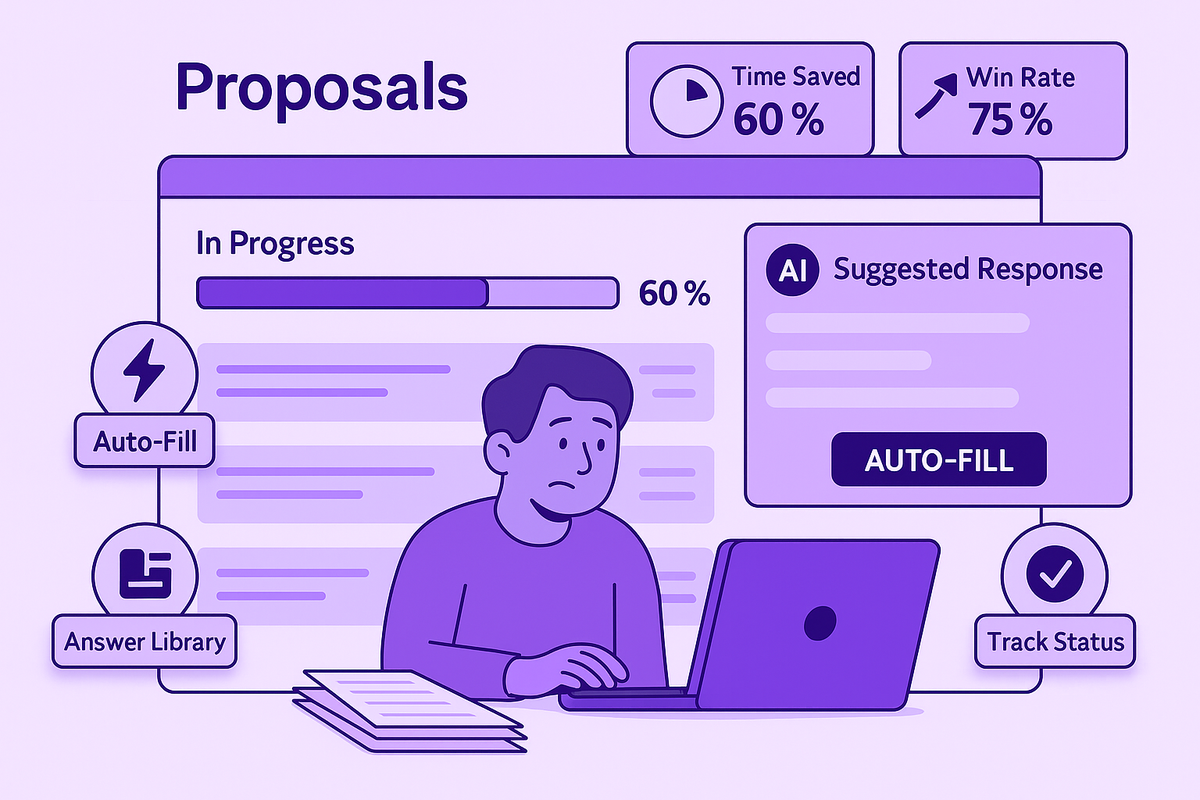
Proposals are where the deal gets real, but they can also be a major bottleneck. Manually assembling custom documents for every opportunity eats up valuable time your sales team could be spending on strategy and customer relationships. This is where AI changes the game. It’s not just about working faster; it’s about producing higher-quality, more accurate proposals that are tailored to each prospect's needs. AI automates the repetitive, administrative tasks, ensuring every proposal is polished, professional, and error-free.
Instead of starting from scratch, your team can use an AI deal desk to instantly generate a first draft by pulling the most relevant, up-to-date information from a central content library. This frees them from hunting down answers and wrestling with formatting. The real advantage is giving your team the bandwidth to focus on the strategic work that actually closes deals—like personalizing the executive summary or crafting a compelling business case. This streamlined process leads to better customer engagement and, ultimately, higher conversion rates.
Effective BOFU Marketing Strategies That Convert
Bring Back Ready-to-Buy Visitors with Retargeting
Prospects who've visited pricing pages, viewed case studies, or spent significant time on your site signal BOFU intent. Retarget them with:
- Testimonial ads featuring relevant customers
- Limited-time offer promotions
- Demo or trial invitations
- Competitor comparison content
Retargeting keeps your solution top-of-mind during the decision process.
Nurture Decision-Makers with Targeted Emails
When prospects engage with BOFU content, trigger focused email sequences:
- Customer success stories relevant to their industry
- Answers to common final objections
- Consultation or demo offers
- Social proof and validation
Sequence timing matters—prospects at BOFU want to move quickly.
Equip Your Sales Team to Close More Deals
Equip sales teams with materials for BOFU conversations:
- Objection handling guides
- Competitive battlecards
- Custom demo scripts by industry/use case
- ROI frameworks and calculators
Marketing creates the assets; sales deploys them in prospect conversations. Modern sales enablement platforms centralize these resources for easy access.
Design Landing Pages That Convert
BOFU landing pages should minimize friction:
- Clear value proposition and proof points
- Prominent call-to-action
- Social proof (logos, testimonials, reviews)
- Trust signals (security certifications, guarantees)
- Minimal form fields
Test continuously—small improvements in BOFU conversion yield significant revenue gains.
Use Personalized Outreach to Start Conversations
Generic email blasts won't cut it when a prospect is moments from making a decision. At the bottom of the funnel, they are actively comparing you to alternatives, and your outreach needs to differentiate your solution clearly. Instead of a generic "checking in" email, use their recent activity as a conversation starter. If they downloaded a case study about the finance industry, follow up with another relevant customer story or offer to connect them with a finance expert on your team. If they engaged with a competitor comparison guide, send a follow-up that addresses a common objection or highlights a key feature they might have missed. This tailored approach shows you've been paying attention and are prepared to solve their specific problems, not just sell a product.
How Do You Measure BOFU Success?
Track Your Lead-to-Customer Conversion Rate
What percentage of BOFU prospects become customers? Track conversion from:
- Demo requests to demos completed
- Demos to proposals
- Proposals to closed-won
- Trial signups to paid conversion
Identify and fix the biggest conversion gaps.
Measure (and Shorten) Your Sales Cycle
How long do prospects spend at BOFU? Faster is generally better (assuming quality), but track:
- Average days from demo request to close
- Deal velocity by segment, source, or rep
- Stages where deals stall
Long cycles at BOFU suggest content or process gaps.
Which Content Pieces Are Closing Deals?
Which BOFU content influences closed deals? Track:
- Content consumed by won vs. lost opportunities
- Asset downloads before close
- Pages viewed in final decision stage
Double down on content that correlates with wins.
Tie Your BOFU Content Directly to Revenue
Connect BOFU activities to business outcomes:
- Pipeline influenced by BOFU campaigns
- Revenue attributed to BOFU content
- Customer acquisition cost for BOFU-sourced deals
Prove marketing's impact on revenue, not just leads.
Common BOFU Mistakes to Avoid
Mistake: Creating One-Size-Fits-All Content
BOFU prospects have specific needs. Generic messaging that could describe any vendor doesn't help them choose you. Get specific about:
- Who you serve best
- What results you deliver
- How you differ from alternatives
Mistake: Forgetting About Your Competitors
Pretending competitors don't exist doesn't make them disappear. Prospects are evaluating alternatives whether you acknowledge it or not. Address the comparison proactively with honest, confident positioning.
Mistake: Making It Hard for People to Buy
Complex forms, unresponsive scheduling, slow proposal turnaround—friction at BOFU costs deals. Audit your buying process from the prospect's perspective. Every unnecessary step is an opportunity to lose.
Mistake: When Sales and Marketing Don't Talk
When marketing creates BOFU content sales doesn't use—or sales requests assets marketing doesn't produce—everyone loses. Regular communication and shared metrics keep teams aligned.
Mistake: Pushing for a Hard Sell Instead of Helping
It’s tempting to apply pressure when a prospect is so close to the finish line, but old-school, hard-sell tactics often backfire at the BOFU stage. These buyers are informed and have already evaluated their options. They aren't looking for a sales pitch; they're looking for a trusted partner who can confidently solve their specific problem. Instead of pushing for the close, shift your focus to helping them make the best decision. Your role is to be a resource, providing clear comparisons, personalized demos, and transparent answers. The goal is to teach and provide useful resources, not to pressure them. This consultative approach builds the trust needed to finalize the deal and ensures they become a happy, long-term customer who wasn't pushed into a purchase they weren't ready for.
Mistake: Forgetting Customers After They Buy
BOFU doesn't end at signature. The transition from prospect to customer is a BOFU experience. Smooth handoffs, clear onboarding, and early value delivery prevent buyer's remorse and set up long-term success.
Frequently Asked Questions
How do I know if a prospect is at BOFU?
Behavioral signals include: visiting pricing pages, requesting demos, consuming case studies, returning multiple times, or explicitly stating they're evaluating vendors. Lead scoring models can automate BOFU identification based on engagement patterns.
Should all content be gated at BOFU?
Not necessarily. Some BOFU content (pricing, basic case studies) benefits from being accessible—friction can deter prospects. Gate content that provides significant value exchange (detailed ROI analyses, custom assessments) or requires sales follow-up.
How does BOFU work in product-led growth?
PLG often compresses BOFU—prospects self-serve through trials, experiencing the product directly rather than consuming traditional BOFU content. BOFU in PLG focuses on conversion optimization within the product experience, upgrade prompts, and self-service purchasing.
What's the right balance between TOFU, MOFU, and BOFU investment?
There's no universal answer—it depends on your funnel shape and conversion rates. If BOFU conversion is strong but pipeline is thin, invest more in TOFU. If plenty of leads exist but deals don't close, focus on BOFU. Measure and balance based on your specific constraints.
How do long sales cycles affect BOFU strategy?
Long cycles require sustained BOFU engagement—multiple touchpoints, relationship building, and continued value demonstration over months. Content should address evolving stakeholders and changing requirements. Patience and persistence matter more than urgency tactics.
Implement a Retention of Funnel (ROFU) Strategy
Think of Retention of Funnel (ROFU) as the crucial next chapter after BOFU. The goal is no longer just to close the deal but to reinforce the customer's decision and turn them into a long-term partner. The same principles apply: generic messaging won't work. Just as specific content helped them choose you, tailored post-sale communication helps them stay. This means providing a smooth onboarding experience, sharing advanced use cases relevant to their goals, and proactively offering support. A strong customer retention strategy proves you can continue delivering results long after the contract is signed. It all starts with the promises made during the sales process. When proposals and contracts are clear and customized, they set accurate expectations, creating a foundation of trust that makes retention much easier to achieve.
Related Resources
- The Essential Guide to Writing RFP Responses
- What Is Proposal Automation Software?
- Case Studies
Key Takeaways
- Show, Don't Just Tell: When prospects are ready to buy, they need concrete proof, not just promises. Use detailed case studies, customer testimonials, and live demos to show exactly how your solution solves their problems and delivers real results.
- Tailor Your Content to Win the Comparison: At this final stage, buyers are actively comparing you to competitors. Generic messaging won't cut it; you need specific content like competitor comparison guides and ROI calculators that directly address their unique needs and prove why you're the best choice.
- Make the Buying Process Effortless: A complicated final step can kill a deal. Streamline the purchasing experience with clear pricing, simple forms, and fast proposal generation to remove any last-minute friction and make it easy for prospects to sign on.
Share this post
Link copied!







_EasiestToDoBusinessWith_EaseOfDoingBusinessWith.svg)
_HighPerformer_HighPerformer.svg)





_BestSupport_QualityOfSupport.svg)


