
Pipeline Coverage: A Practical Guide to Forecasting
February 11, 2026
By
Evie Secilmis
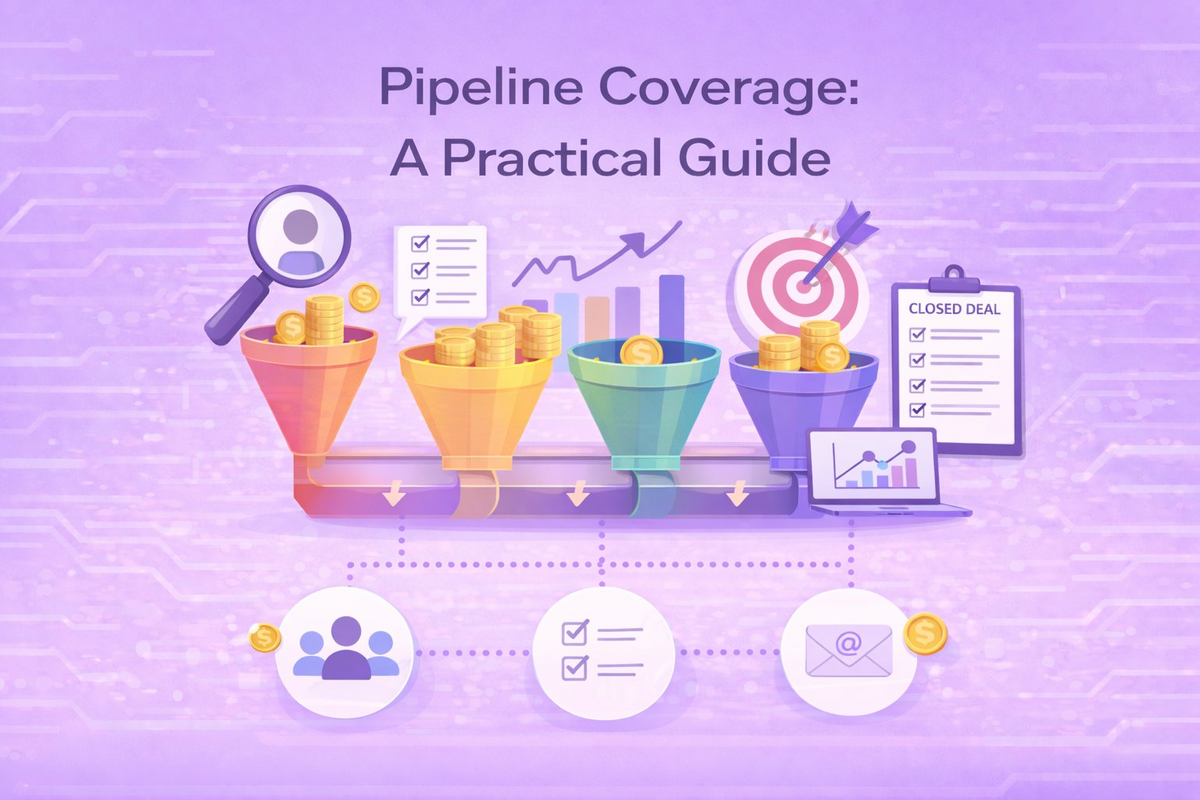

For decades, sales leaders have passed down the "3x rule" as gospel: you need three dollars in your pipeline for every dollar of your quota. But this one-size-fits-all advice is often wrong, leading teams to either chase too many low-quality deals or feel a false sense of security. The truth is, the right pipeline coverage ratio depends entirely on your team’s win rate, sales cycle, and market segment. A team with a 50% win rate needs a very different pipeline than one with a 25% win rate. This guide will show you how to ditch the generic rules and calculate the precise pipeline coverage your team actually needs to hit its number predictably.
Pipeline Coverage: A Practical Guide
Pipeline coverage is the ratio of your total pipeline value to your revenue target for a given period. If you have $3 million in pipeline and a $1 million quota, your pipeline coverage ratio is 3x. Simple math, but the implications are anything but simple.
Sales leaders use pipeline coverage as an early warning system. Too little coverage and you are almost certainly going to miss your number. Too much and you might be wasting resources on deals that will never close. The trick is knowing what "enough" looks like for your specific business, because the old blanket rule of "you need 3x coverage" is often wrong.
Understanding Key Pipeline Metrics
Pipeline Coverage vs. Forecast Coverage
It’s easy to get pipeline coverage and forecast coverage mixed up, but they tell you two very different stories about your sales health. Think of pipeline coverage as the wide-angle lens; it shows you all the potential deals moving through your sales process. It answers the big question: "Do we have enough potential sales volume to even have a chance at hitting our goal?" It’s your total pool of opportunities, including the long shots and the sure things.
Forecast coverage, on the other hand, is the close-up shot. It’s a much more refined prediction of what you will actually sell in a specific period. This metric uses data like historical win rates and deal stage to create a realistic estimate of what will close. While your pipeline coverage might be a healthy 4x, your sales forecast might show you’re on track to miss your quota because many of those deals are stuck in early stages. Both are critical, but they serve different purposes for planning and strategy.
Pipeline Coverage vs. Pipeline Velocity
If pipeline coverage tells you if you have *enough* deals, pipeline velocity tells you *how fast* those deals are moving. You can have a pipeline packed with promising opportunities, but if they take forever to close, you’ll still have a revenue problem. Pipeline velocity measures the speed at which a qualified lead becomes a closed-won deal. A high velocity means your sales process is efficient and deals are progressing smoothly from one stage to the next.
Smart sales teams track both metrics because they reveal different parts of the story. If your coverage is high but your velocity is low, it’s a sign that deals are getting stuck somewhere. This could be due to a number of factors, from a complicated approval process to slow responses on complex documents like RFPs. Conversely, if deals move quickly but you don’t have enough of them, your focus should be on top-of-funnel lead generation. Balancing both is key to a predictable sales pipeline.
The Core Components of Pipeline Coverage
To get a firm grip on your pipeline coverage, you need to understand what goes into it. It’s not just one number; it’s a calculation based on a few key elements that give you a complete picture of your sales landscape. When you break it down, you can see exactly where your strengths and weaknesses lie. There are three main components you need to look at to truly understand what your pipeline coverage ratio is telling you.
First is the Total Value of Opportunities, which is the combined potential revenue of every deal in your pipeline. Second is your Expected Close Rate, or the historical percentage of opportunities that your team successfully converts into customers. Finally, there’s the Time Frame for Revenue Realization, which is simply your average sales cycle length. These three components work together to show not just how much potential revenue you have, but how much you can realistically expect to close and when.
How to Calculate Pipeline Coverage
The basic pipeline coverage formula is straightforward: divide your total pipeline value by your revenue target for the period. A $3M pipeline against a $1M target gives you 3x coverage. But the way you count your pipeline changes the answer significantly.
Unweighted pipeline coverage counts the full value of every open deal. If you have ten deals worth $100K each, your pipeline is $1M regardless of stage. This is the simplest version but also the least accurate, because a deal in late-stage negotiation is fundamentally different from one that just entered discovery. An unweighted number can lull you into false confidence if most of your pipeline is early-stage.
Weighted pipeline coverage adjusts each deal's value by its probability of closing based on stage. A $100K deal at 80% probability counts as $80K, while one at 20% counts as $20K. This gives you a more realistic picture of your likely revenue, assuming your stage-based probabilities are calibrated correctly. That calibration is a big assumption, and it is worth auditing your historical conversion rates by stage at least once a quarter to keep your weighted numbers honest.
Most sales leaders track both. Unweighted coverage tells you whether you have enough at-bats. Weighted coverage tells you whether those at-bats are likely to produce runs. The gap between the two numbers tells you how much of your pipeline is early-stage versus late-stage, which is a useful signal on its own.
The Pipeline Coverage Formula
Let's get straight to the point. The core formula is simple and acts as your starting point for understanding your sales health. You calculate it by dividing the total value of all opportunities in your pipeline by your sales target for that same period. For instance, if your pipeline holds deals worth a total of $4 million and your quarterly target is $1 million, you have a 4X pipeline coverage ratio. This number gives you a high-level snapshot of whether you have enough potential business in the works to hit your quota. It’s the first, most basic check-in for any sales leader to gauge if the team is on the right track.
Weighted vs. Unweighted Pipeline
Not all pipeline is created equal, and that’s where the distinction between unweighted and weighted pipelines comes in. An unweighted pipeline is the simplest view—it counts every single deal at its full potential value, assuming a 100% chance of closing. It’s a good way to see the total volume of opportunities you're working with. However, a weighted pipeline offers a more realistic forecast. It calculates a deal's value by multiplying it by the probability of it closing, which usually corresponds to its sales stage. This method correctly acknowledges that a deal in the final negotiation stage is worth more to your forecast than one you just had a discovery call for.
Calculating Expected Revenue
Ultimately, pipeline coverage is all about forecasting and managing performance. The ratio directly helps you calculate your expected revenue and assess whether you're on track to meet your goals. By using the formula—Total Value of Opportunities in Pipeline / Expected Revenue for a Period—you can see if you have enough buffer to account for deals that will inevitably slip or be lost. This isn't just a vanity metric; it's a crucial tool for strategic resource planning. Knowing your coverage helps you decide whether your team needs to focus on generating new leads or accelerating existing deals to close any gaps before the end of the quarter.
Why the 3x Rule Is Misleading
The conventional wisdom says you need 3x pipeline coverage to hit your number. This "rule" has been passed around sales organizations for decades, but it is based on an average win rate of roughly 33%. If your win rate is higher or lower, 3x is the wrong target.
A team with a 50% win rate only needs 2x coverage to be on track. A team with a 20% win rate needs 5x. Applying a blanket 3x ratio regardless of your actual win rate leads to either false confidence (you think you have enough when you do not) or wasted effort (you are generating pipeline you do not need, spreading your team too thin across too many deals).
The right coverage ratio for your team is: 1 divided by your historical win rate, plus a buffer for slippage. If your win rate is 25%, your baseline coverage need is 4x. Add a 10 to 20% buffer for deals that push to next quarter, and you are looking at 4.5 to 5x.
This is why tracking win rate by segment, deal size, and rep is essential. Your SMB team might need 3x while your enterprise team needs 6x because enterprise deals have lower win rates, longer cycles, and more opportunities for deals to stall or die. A single coverage target across the entire org hides these differences and makes your forecast less reliable.
What Is a Good Pipeline Coverage Ratio?
The "right" pipeline coverage ratio isn't a universal number; it's specific to your sales motion. The ideal target depends on your industry, average sales cycle length, and historical win rates. Think of it less as a magic number to hit and more as a health indicator that tells you if you have enough opportunities in play to realistically reach your revenue goals. While one team might thrive with 2x coverage, another might need 5x just to stay on track. The key is to move beyond generic rules and find the figure that accurately reflects the dynamics of your own sales process.
Industry Benchmarks by Sales Team
While your own data is the ultimate source of truth, industry benchmarks can provide a helpful starting point. For teams managing large, complex enterprise sales with long cycles, a ratio between 3x and 5x is common. The higher coverage accounts for lower win rates and the extended time it takes to close a deal. In the mid-market space, where deal sizes are moderate and cycles are a bit shorter, teams often aim for 2.5x to 4x coverage. For businesses focused on high-velocity, smaller SMB deals, the target is typically lower, around 2x to 3x, because these sales processes are faster and tend to have higher conversion rates. Use these figures as a guide, but always measure them against your own historical performance to find your true number.
Warning Signs: Ratios That Are Too High or Too Low
Your pipeline coverage ratio is a health metric, and extremes on either end can signal trouble. A consistently low ratio, especially anything below 2x, is a clear warning sign that you're unlikely to hit your quota. This could mean your lead generation isn't keeping up, your qualification process is weak, or your sales targets are simply unrealistic. On the other hand, an excessively high ratio of 5x or more isn't something to celebrate. It often indicates a bloated pipeline filled with stale, low-quality deals that reps are holding onto. This "pipeline padding" ties up resources and distracts your team from focusing on winnable opportunities. A clean, realistic pipeline allows your team to dedicate their energy to crafting high-quality proposals for deals that are actually moving forward, which is a far better path to hitting your number.
Building Pipeline Coverage That Converts
Raw coverage numbers can create a false sense of security. A pipeline full of poorly qualified deals is worse than a smaller pipeline of well-qualified ones. Here is how to build coverage that actually translates to closed revenue.
Qualify ruthlessly at the top. Every deal that enters your pipeline should meet basic qualification criteria. Using a framework like MEDDIC helps ensure your team is not inflating coverage with deals that have no real path to close. If your rep cannot identify the economic buyer, articulate the decision criteria, or name a champion inside the account, the deal should not be in your committed pipeline. The tighter your qualification, the more predictive your coverage ratio becomes.
Balance pipeline by stage. Healthy coverage is not just about total value. It is about having deals distributed across stages in a way that matches your sales cycle timing. If 80% of your pipeline is in early discovery with three weeks left in the quarter, you have a near-term problem even if your total coverage looks healthy. Map your pipeline by stage and by expected close date to identify gaps before they become emergencies.
Accelerate mid-funnel deals. The biggest leverage point for improving coverage quality is reducing the time deals spend in the middle of your funnel, specifically the evaluation, technical review, and procurement stages. Deals stall here when your team cannot respond quickly to RFPs, security questionnaires, or due diligence requests. Every day a deal sits in the evaluation stage is a day it can be displaced by a competitor, deprioritized by the buyer, or lost to budget reallocation.
Compressing this stage improves both your win rate and your pipeline velocity, which means deals convert faster and your coverage ratios become more reliable. Teams that use AI-powered tools to accelerate RFP and questionnaire responses consistently see shorter sales cycles. When your sales engineer can turn around a 200-question security questionnaire in hours instead of a week, deals do not stall. They move. See how teams like MedRisk and Corelight clear this bottleneck.
Clean your pipeline regularly. Dead deals that sit in your CRM for months inflate your coverage numbers and distort your forecast. Set clear rules for when deals should be moved to closed-lost: no activity in 30 days, no next step scheduled, or the prospect has gone dark after repeated outreach. A clean pipeline with 3x coverage is far more valuable than a bloated pipeline showing 5x.
### Start with Your Ideal Customer Profile (ICP) The foundation of a healthy pipeline isn’t just volume; it’s alignment. Before you even think about coverage ratios, you need a crystal-clear definition of your Ideal Customer Profile (ICP). This is a detailed description of the perfect company for your product—the one that experiences the most value, has the highest retention, and becomes your biggest advocate. When your pipeline is filled with ICP-fit deals, your win rates naturally go up, your sales cycles shorten, and your coverage targets become more attainable. Chasing deals far outside your ICP might temporarily inflate your pipeline numbers, but it clogs your funnel with low-probability opportunities that drain resources and demoralize your team. A disciplined focus on your ICP is the first and most important filter for building a pipeline that actually converts. ### Align Coverage with Your Go-to-Market (GTM) Strategy A single pipeline coverage target for your entire sales organization is rarely effective. Your coverage goals must be tailored to your go-to-market strategy and the specific segments you serve. For example, your team selling to small and medium-sized businesses (SMBs) might have a quick, transactional sales cycle and a high win rate, requiring only 3x coverage. Meanwhile, your enterprise team, which navigates long sales cycles, complex procurement processes, and lower win rates, might need 6x coverage or more to reliably hit their number. Applying a blanket 3x rule to both teams would leave your enterprise reps scrambling at the end of the quarter. Your GTM strategy should dictate your coverage needs, not the other way around. ### Segment Your Pipeline Coverage Analysis To get a true reading on your pipeline's health, you have to look deeper than the top-line number. A single coverage ratio can hide significant issues within your team or strategy. Segmenting your pipeline allows you to move from a broad, often misleading, average to a precise, actionable diagnosis. By breaking down your coverage by factors like individual rep, territory, deal size, or product line, you can pinpoint exactly where your pipeline is strong and where it needs attention. This granular view is what separates reactive sales leaders from proactive ones. #### Analyze by Rep, Territory, or Deal Type Once you start segmenting, you can set more intelligent targets. A new sales rep who is still learning the ropes will naturally have a lower win rate and may need 5x or 6x coverage to hit their quota. In contrast, a seasoned veteran with a 40% win rate might only need 2.5x. The same logic applies to territories; a new market requires more pipeline to account for a lower initial win rate compared to an established region. You can calculate the baseline need for each segment using a simple formula: 1 divided by that segment’s historical win rate. This approach ensures every part of your sales engine has the fuel it needs to perform. #### Improve Response Quality to Strengthen the Pipeline A high coverage ratio is useless if your deals consistently stall during the evaluation stage. This is where buyers scrutinize your solution, often by issuing detailed RFPs, security questionnaires, and SOWs. The quality and speed of your responses at this critical juncture directly impact your win rate. Slow, generic, or inaccurate answers create doubt and give competitors an opening. Strengthening this part of your sales process makes your entire pipeline more robust. By using an AI deal desk platform, your team can generate precise, high-quality responses in hours, not weeks. This speed keeps deals moving, improves your win rate, and ultimately makes your pipeline coverage a far more reliable indicator of future revenue.Using Pipeline Coverage in Your Forecast
Pipeline coverage is a leading indicator, not a prediction. It tells you whether you have enough opportunity to hit your target, not whether you will. Pairing coverage with other signals gives you a more accurate forecast.
Look at coverage alongside deal velocity (how fast deals move through stages), stage conversion rates (what percentage of deals advance from one stage to the next), and commit versus best case pipeline (deals your reps are confident about versus deals that could go either way). Together, these metrics paint a picture that coverage alone cannot provide.
One of the most useful exercises for sales leaders is a monthly pipeline coverage trend analysis. Are you building coverage fast enough relative to the quarter timeline? If you are at 4x coverage on day one of the quarter but 2x by day 45 because deals are closing or falling out faster than new ones enter, you have a generation problem that needs immediate attention. Conversely, if your coverage is growing but your weighted number stays flat, your new pipeline is mostly early-stage and unlikely to close this quarter.
The best forecasting teams also track coverage by deal source. Pipeline from inbound marketing, outbound prospecting, events, and partner referrals often converts at different rates. If your coverage is strong but skewed toward a source with historically lower win rates, your forecast should reflect that risk. This level of granularity separates the sales leaders who consistently hit their number from those who are perpetually surprised.
Using Coverage as a Sales Coaching Tool
Pipeline coverage is more than a forecast input; it's a powerful diagnostic tool for one-on-one coaching. When a rep has a high coverage ratio but a low win rate, it’s a clear signal to coach them on qualification. A pipeline filled with poorly qualified deals creates a false sense of security and wastes time. The conversation shifts from "hit your number" to "let's review your deals against our qualification criteria." Similarly, if a rep's pipeline is front-loaded with early-stage deals, you can coach them on strategies to advance opportunities through the mid-funnel. This is often where deals stall waiting for responses to security questionnaires or RFPs. By identifying and clearing these bottlenecks, you not only improve their pipeline velocity but also build their confidence. Regularly reviewing their pipeline to clean out dead deals also teaches discipline, ensuring they focus their energy on opportunities with a real chance to close.
What to Do When Coverage Drops
Every sales leader has experienced the sinking feeling of watching pipeline coverage erode mid-quarter. Here is how to respond, depending on the root cause.
Deals pushing to next quarter. This is the most common cause of coverage drops. Deals do not die; they just slip. The fix is better deal control: are there clear next steps with dates? Has your team confirmed the buyer's timeline? Is the decision process fully mapped? Deals push because buyers lose urgency, and the best way to prevent that is to maintain momentum through responsive, fast engagement at every stage.
Deals lost to competitors. If you are losing deals in the evaluation stage, dig into why. Are competitors responding faster to RFPs and technical assessments? Are they offering better proof points? Are your reps losing access to the economic buyer? Win/loss analysis is one of the most underused tools in sales leadership. A structured debrief on every significant loss gives you the intelligence to prevent the next one.
Slow pipeline generation. If coverage drops because new pipeline is not entering fast enough, the problem is upstream. Review your outbound activity levels, marketing pipeline contribution, and event/referral channels. If your team is spending too much time on deal execution and not enough on prospecting, you may need to rebalance or invest in demand generation to fill the gap.
Frequently Asked Questions
What is a good pipeline coverage ratio?
It depends on your win rate. Divide 1 by your historical win rate and add a 10 to 20% buffer. A team with a 25% win rate needs roughly 4.5 to 5x coverage. A team winning 40% of deals needs about 2.8 to 3x. There is no universal "right" number.
What is the pipeline coverage formula?
Pipeline coverage equals total pipeline value divided by revenue target. For weighted coverage, multiply each deal's value by its stage-based close probability before summing. For example: ($100K deal at 80% + $200K deal at 30%) / $100K quota = ($80K + $60K) / $100K = 1.4x weighted coverage.
Should I use weighted or unweighted pipeline coverage?
Track both. Unweighted shows your total opportunity volume. Weighted gives a more realistic view of expected revenue. The gap between the two tells you how much of your pipeline is early-stage versus late-stage, which helps you assess near-term risk.
How often should I review pipeline coverage?
Weekly for your sales leadership team, with a deeper monthly review that includes trend analysis and segment-level breakdowns. Real-time dashboards in your CRM help reps self-monitor between formal reviews.
What causes pipeline coverage to drop mid-quarter?
The three main causes are deals pushing to next quarter, competitive losses, and slower-than-expected pipeline generation. Stalled deals in the evaluation or procurement stage are a common culprit, especially when security reviews or RFP responses create bottlenecks that extend your sales cycle.
### Short-Term Fixes for a Low Ratio When your pipeline coverage is looking thin mid-quarter, you need to act fast. The quickest way to add qualified pipeline is often by looking at your existing customer base. These relationships are already warm, and the sales cycles for upsells or cross-sells are typically much shorter than for new logos. Talk to your customer success team to identify accounts that are prime for expansion. Another effective short-term tactic is to pull deals forward. If you have late-stage deals scheduled to close next quarter, a small, time-sensitive discount or a value-added service might provide the incentive your champion needs to get the deal signed before the end of the current period. ### Long-Term Strategies for Pipeline Health Quick fixes can save a quarter, but long-term pipeline health requires discipline and strategy. The goal is to build a predictable revenue engine, not just scramble to fill gaps. This starts with a commitment to pipeline quality over quantity; a clean pipeline with 3x coverage is far more valuable than a bloated one showing 5x. Implement strict pipeline hygiene rules. For example, set clear criteria for moving a deal to closed-lost, such as no meaningful activity in 30 days or a prospect going dark after multiple outreach attempts. This prevents your CRM from becoming a graveyard of dead deals that inflate your coverage and create a false sense of security. Consistently refining your qualification process and ensuring reps focus on high-quality opportunities will make your coverage ratio a far more reliable indicator of future success. ### Common Challenges to Watch For Even with a solid strategy, maintaining healthy pipeline coverage involves managing factors both inside and outside your control. Two of the most common challenges that can derail your forecast are poor data quality and shifting market conditions. #### Maintaining Data Quality Inaccurate or incomplete CRM data makes your pipeline coverage numbers completely unreliable. If deal sizes are wrong, close dates are just guesses, or contact information is outdated, you’re making strategic decisions based on flawed information. This is a foundational issue that undermines everything from individual rep coaching to company-wide forecasting. The solution is operational rigor: enforce mandatory fields for deal creation, conduct regular data audits, and train your team on the importance of maintaining a clean CRM. It’s not the most exciting part of sales, but without trustworthy data, your pipeline metrics are meaningless. #### Adapting to Market Changes Your pipeline doesn’t exist in a vacuum. Economic shifts, new competitor moves, and changes in customer behavior can all impact your deal velocity and win rates overnight. A coverage ratio that was healthy last quarter might be insufficient in a tougher economic climate where buyers are more cautious and sales cycles are longer. Staying ahead requires you to be a student of your market. Pay attention to industry news, listen for new objections on sales calls, and regularly review your buyer's journey to ensure your sales process is still aligned with how your customers want to buy. The most successful sales leaders are agile, adjusting their strategies as market conditions evolve.Keep Your Pipeline Moving
Pipeline coverage only matters if deals convert. If your team is losing time and momentum during the evaluation stage, the problem is not coverage. It is velocity. Iris helps sales teams clear the bottlenecks that stall mid-funnel deals, turning multi-day response cycles into same-day deliverables. Book a demo to see how it works for your team.
Key Takeaways
- Ditch the 3x rule for a custom target: Your ideal pipeline coverage isn't a universal number; it's based on your team's performance. Calculate your true need by dividing 1 by your historical win rate, then add a small buffer for deals that might slip.
- Prioritize quality to create a predictable pipeline: A high coverage ratio is meaningless if it's full of unqualified deals. Build a more reliable forecast by qualifying opportunities ruthlessly and regularly removing stale deals that waste your team's time.
- Speed up your mid-funnel to protect your win rate: A healthy pipeline can still fail if deals stall during evaluation. Keep momentum by providing fast, accurate responses to RFPs and security questionnaires, which prevents deals from dying on the vine.
Related Articles
Share this post
Link copied!








_EasiestToDoBusinessWith_EaseOfDoingBusinessWith.svg)
_HighPerformer_HighPerformer.svg)





_BestSupport_QualityOfSupport.svg)


