
RFP Response Time: 2026 Benchmarks & How to Cut It
April 20, 2026
By
Iris AI

Most sales teams don't have an RFP response time problem. They have a process problem — and response time is just the symptom. The average enterprise RFP takes 20–40 hours to complete manually. Teams with a structured process and the right tools cut that to under 5 hours. This guide breaks down what RFP response time actually means, what industry benchmarks look like in 2026, what drives slow turnarounds, and how AI is changing the math entirely.
What Is RFP Response Time?
RFP response time is the total elapsed time from when your team receives an RFP to when a completed, polished response is submitted. It includes every stage: reading and qualifying the RFP, assigning sections, gathering information from subject matter experts (SMEs), drafting responses, reviewing for accuracy and compliance, and final formatting and submission.
Response time is distinct from response quality — but the two are deeply connected. Teams under time pressure tend to recycle stale answers, skip reviews, and submit inconsistent responses. Faster response time, when achieved through better process rather than shortcuts, correlates directly with higher win rates.
RFP Response Time Benchmarks (2026)
Response time varies significantly by company size, industry, and process maturity. Based on industry data from APMP, Forrester, and Salesforce:
- Manual process, no content library: 30–40+ hours per RFP
- Content library, manual assembly: 15–25 hours per RFP
- AI-assisted drafting with a maintained knowledge base: 3–7 hours per RFP
- AI-native automation (high library coverage): Under 2 hours for familiar question sets
The gap between the top and bottom of that range isn't talent — it's infrastructure. Teams at the bottom are reinventing the wheel on every submission. Teams at the top have built systems that treat each RFP as an incremental improvement on the last.
For context, 60–80% of questions across RFPs repeat (APMP, 2024). That means the majority of every new RFP should already be answered in your content library. When it isn't, you're paying the time cost of re-answering questions your team has solved dozens of times before.
Why RFP Response Time Matters for Win Rates
Procurement teams notice response quality, not just speed — but speed signals operational maturity. A well-organized, complete response submitted on time sends a different message than a rushed submission that arrived 10 minutes before the deadline.
More practically, slow internal processes create compounding problems:
- SME bottlenecks. When technical or compliance questions stack up waiting for the right expert, deals stall. If your SE-to-rep ratio is stretched and SMEs are already handling live deals, a 40-question RFP becomes a week-long negotiation for their attention.
- Stale content risk. Teams under time pressure grab the nearest available answer rather than the most current one. A product capability that was accurate 18 months ago may no longer be — and submitting it creates liability.
- Selective bidding. When each RFP costs 25+ hours, teams skip opportunities that aren't clearly winnable. AI-powered teams respond to more RFPs at higher quality because the marginal cost of each additional response is lower.
The 5 Biggest Drivers of Slow RFP Response Time
1. No centralized knowledge base
The single biggest driver of slow response time is the absence of a structured knowledge base for RFP responses. When your team hunts through old proposals, Slack threads, and shared drives to find approved answers, you're spending the majority of your response time on retrieval — not writing. A maintained knowledge base eliminates this step entirely for repeat questions.
2. SME availability
Security, compliance, and technical questions require input from people who are almost never dedicated to RFP work. They're in customer calls, fixing production issues, or leading product sprints. Without a system to route questions efficiently and store their approved answers for reuse, every RFP starts from zero on the questions they own.
3. Review and approval cycles
Most teams have one reviewer who becomes the bottleneck for every submission. When that person is out of office, on vacation, or simply overloaded, responses sit idle. Distributing review ownership and building version-controlled approval workflows removes this single point of failure.
4. Formatting and assembly time
Manually copying answers into procurement portals, formatting tables, reconciling fonts, and assembling attachments can consume 4–6 hours on a long RFP — work that produces zero value and is almost entirely automatable.
5. Unclear ownership
When no one is explicitly responsible for a section, it either gets done at the last minute or falls through the cracks. The teams with the fastest response times have a named owner for every section of every RFP, with deadlines assigned the moment the RFP comes in.
How AI Reduces RFP Response Time
AI doesn't just make individual tasks faster — it changes the structure of the entire response workflow. Here's how it impacts each stage:
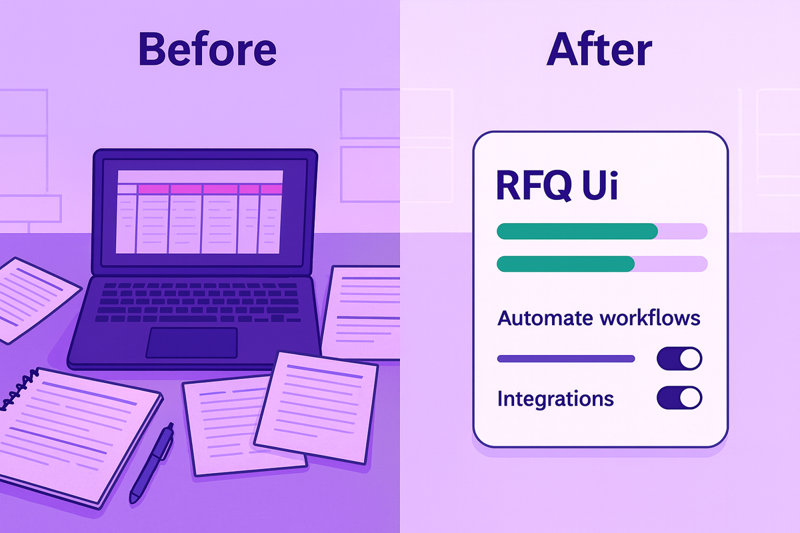
- Instant first drafts. AI generates draft responses to every question by pulling from your approved content library. A question your team has answered before gets a complete, accurate draft in seconds. New questions get a starting point based on similar content. Either way, writers start from a draft, not a blank page.
- Automated SME routing. AI identifies which questions require expert input, routes them to the right person, and tracks response status — eliminating the back-and-forth of figuring out who owns what.
- Content freshness signals. Modern AI RFP tools flag answers that haven't been reviewed recently, prompting SME re-approval before outdated content goes into a submission.
- Parallel section work. AI can draft all sections simultaneously, so the team reviews in parallel rather than waiting on each other in sequence.
Teams using Iris AI report cutting average RFP response time from 20–30 hours to under 5 hours — a reduction that compounds across every opportunity in the pipeline. The faster your team can respond, the more opportunities they can pursue, and the better each response gets as the knowledge base improves with use.
How to Measure Your Current RFP Response Time
Before optimizing, establish a baseline. Track these metrics across your last 10–20 RFPs:
- Total elapsed time — intake to submission
- Active working time — time actually spent on the response (excluding waiting on SMEs or approvals)
- SME response lag — average time between requesting expert input and receiving it
- Reuse rate — percentage of questions answered from existing library content vs. written from scratch
- Late submissions — how often your team misses or nearly misses deadlines
Most teams find that active working time is a small fraction of total elapsed time — the majority of "response time" is actually wait time in queues. Fixing the queue problems (SME routing, approval workflows, content availability) has a bigger impact than making individual writers faster.
Quick Wins to Reduce RFP Response Time This Quarter
You don't need an enterprise platform overhaul to cut response time. These changes have an immediate impact:
- Build or audit your content library. Even a basic, well-organized library of approved Q&A pairs for your 50 most common questions eliminates a significant portion of per-RFP work. See how to build a knowledge base for RFP responses from scratch.
- Assign a response lead for every RFP. One named person is accountable for the timeline, owns section assignments, and chases down late contributors. This alone removes most coordination overhead.
- Set internal deadlines 48 hours before the external deadline. Build buffer into your process so late contributions don't become emergency submissions.
- Create a standard intake checklist. The first 2 hours of every RFP should look the same: qualify, assign, set deadlines, identify new questions that need SME input. Systematizing intake eliminates the chaotic start that costs teams hours of misaligned work.
The Bottom Line
RFP response time is a proxy for process maturity. Teams that respond in under 5 hours aren't smarter or faster writers — they've built systems that eliminate the retrieval, routing, and assembly work that consumes most of the time. The benchmarks are clear: manual teams spend 20–40 hours per RFP, AI-native teams spend under 5. That gap compounds across every opportunity in your pipeline — more bids, higher quality, better win rates.
The starting point for faster RFP response time is always the same: a well-maintained knowledge base for RFP responses that gives your team — and your AI — the approved content it needs to move fast without sacrificing accuracy.
See how Iris cuts RFP response time for B2B teams — and what your auto-fill rate would look like on your actual RFPs.
Share this post
Link copied!







_EasiestToDoBusinessWith_EaseOfDoingBusinessWith.svg)
_HighPerformer_HighPerformer.svg)





_BestSupport_QualityOfSupport.svg)


