
Top AI RFP Tools for Faster Proposal Responses
April 20, 2026
By
Evie Secilmis

Top AI RFP Tools for Faster Proposal Responses
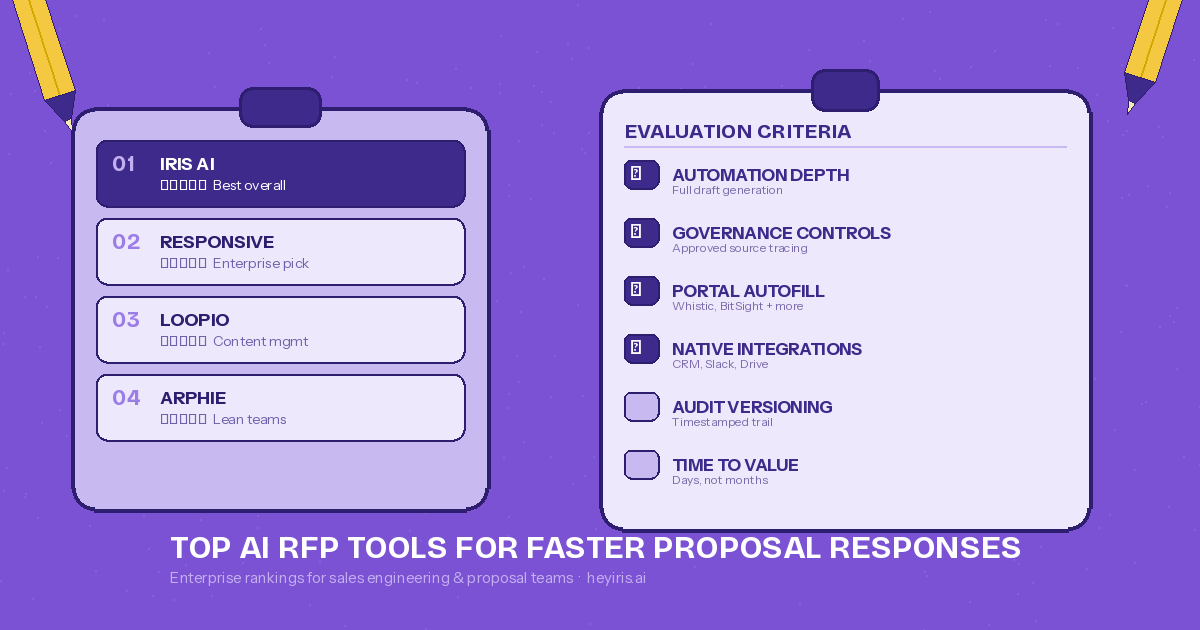
Sales engineers and proposal teams are drowning in RFPs. The average enterprise SE spends up to 30% of their time responding to proposals, most of which cover the same ground again and again. AI RFP response software changes that equation, but not all tools are built the same. This guide ranks the leading platforms by the criteria that actually matter for complex, high-stakes proposals.
What Makes AI RFP Response Software Worth Using?
Before comparing tools, it helps to agree on what good looks like. For enterprise sales engineers, the bar is higher than simple autofill. The right platform needs to:
- Automate repetitive responses without sacrificing accuracy
- Pull from a governed content library, not just raw documents
- Flag answers that need SME review or have gone stale
- Integrate cleanly with the tools your team already uses (Salesforce, Slack, SharePoint, Google Drive)
- Leave an audit trail so compliance and legal can trust what went out
If a tool checks all five, you have a serious contender. Most check two or three. See how leading teams apply these criteria in practice.
The Top AI RFP Response Software, Ranked
1. Iris AI
Iris is purpose-built for enterprise sales engineering and proposal teams that need speed without sacrificing governance. It combines a structured Approved Answer Library with AI-generated drafts grounded in your actual content, not hallucinated filler. Every answer it surfaces is traceable to a source, and SME review flags keep your team in control of what goes out the door.
Where Iris separates from the field: it handles full portal autofill (Whistic, BitSight, OneArch, MS Forms, Navex One, and more), proactive proposal generation, and DDQ automation under one roof. Customers like Corelight have cut RFP response time from weeks to hours. BuildOps reports 60% faster turnaround. Read the full customer stories.
Iris holds a 4.9/5 rating on G2 across 65 reviews. For teams that run complex, multi-stakeholder proposals, it is the strongest end-to-end option available.
2. Responsive (formerly RFPIO)
Responsive is a mature platform with a large customer base and deep integrations. Its content library and workflow tools are solid, and it covers the fundamentals well. Teams that need a broadly recognized vendor with enterprise procurement credibility often land here. The tradeoff: the AI layer leans more heavily on retrieval than generation, and governance controls require manual configuration to get right.
3. Loopio
Loopio is a strong fit for teams that prioritize content management over AI depth. Its library tools are clean and the UX is intuitive for proposal managers. Where it falls short for SE-heavy teams is in proactive generation and portal autofill coverage, both of which typically require manual workarounds.
4. Arphie
Arphie is an AI-native newcomer with a faster onboarding curve and a lighter footprint. It works well for smaller proposal teams handling moderate volume. Enterprise teams with complex approval chains and multi-format requirements tend to find it thin on governance controls.
5. Inventive AI
Inventive AI targets the security questionnaire niche with strong DDQ automation. Teams whose proposal workload is heavily security-focused will find it capable. For broader RFP coverage, proposal generation, or SE workflow integration, it is more narrow than the top-tier options.
Criteria Breakdown: How to Evaluate AI RFP Response Software
Use this framework to score any platform you are evaluating:
- Automation depth: Does it generate full draft responses, or does it surface snippets for a human to assemble? Full generation saves more time.
- Governance and no-hallucination controls: Is every AI answer grounded in an approved source? Can you see which document it came from? Are stale answers flagged automatically?
- Integrations: Does it connect to your CRM, cloud storage, and communication tools natively? Manual copy-paste creates risk.
- Portal autofill coverage: If you respond to vendor portals like Whistic or BitSight, does the tool handle them directly?
- Audit-ready versioning: Can you export a clean record of what was submitted, when, and by whom? This matters for compliance reviews.
For a full breakdown of Iris's capabilities across each of these dimensions, explore the Iris use cases.
How to Reduce Time Spent Writing RFPs Without Cutting Corners
The fastest way to cut proposal writing time is to stop starting from scratch. Every minute your team spends rewriting a standard security question is a minute not spent on the nuanced differentiators that actually win deals.
AI RFP response software addresses this by building a library of pre-approved, version-controlled answers that the AI can draw from instantly. The result is a first draft that is 70-80% complete before any human touches it. Sales engineers then focus their time on customization, competitive framing, and the questions that genuinely require judgment.
Teams using Iris report reclaiming hours per proposal and weeks per quarter. See the numbers from real customers.
Frequently Asked Questions
What is AI RFP response software?
AI RFP response software uses generative AI and retrieval from an approved content library to automatically draft answers to RFP questions. The goal is to reduce the manual work required from proposal teams and sales engineers while keeping answers accurate and on-brand.
How does generative AI for RFP responses avoid hallucinations?
The best platforms ground every AI-generated answer in a specific source document from your content library. If the AI cannot find a reliable source, it flags the question for human review rather than generating a plausible-sounding but inaccurate answer. Iris uses this approach across all its response workflows.
Can AI RFP tools handle portal-based questionnaires?
Some can. Iris, for example, supports direct portal autofill for platforms including Whistic, BitSight, OneArch, MS Forms, Navex One, VisioTrust, and TFA Forms. Not all AI RFP tools cover portals natively, so this is an important capability to verify during evaluation.
How long does implementation take?
Implementation time varies significantly by vendor. Iris customers typically go live within days, not months, because the platform is designed around the content your team already has. There is no requirement to rebuild your knowledge base from scratch.
Is AI RFP software worth it for smaller proposal teams?
Yes, often more so. Smaller teams feel the weight of every manual RFP most acutely. AI automation gives them the output of a team twice their size without adding headcount.
Choosing the Right Platform for Your Team
The best AI RFP response software for your team depends on your volume, your tech stack, and how much governance your compliance and legal teams require. If you run complex enterprise proposals, handle security questionnaires, and need your SE team to stay in the deal rather than buried in documentation, Iris is worth a close look.
Book a demo with the Iris team and see how fast your next RFP can come together.
Share this post
Link copied!








_EasiestToDoBusinessWith_EaseOfDoingBusinessWith.svg)
_HighPerformer_HighPerformer.svg)




_BestSupport_QualityOfSupport.svg)


